
Door Refinishing in Annapolis, MD
Expert historic door restoration, front door refinishing, and exterior door staining. Serving the Historic District, Murray Hill, Eastport, and Annapolis Neck with marine-grade finishes built to withstand tidal humidity, Chesapeake salt air, and strong waterfront sun.
Serving every Annapolis neighborhood.

Door Refinishing Washington DC Team
Senior Door Refinishing Specialists · Annapolis Service Area
⏱ 13 min read
Door refinishing in Annapolis MD is a different job than it is anywhere else in the state. Few American cities pack this many irreplaceable entry doors into so small an area, and fewer still surround them with water on three sides. Between the Severn River, Spa Creek, Back Creek, and the open Chesapeake, Annapolis doors absorb tidal humidity, wind-driven salt, and hard afternoon sun. Then they sit under a Historic Preservation Commission that expects original fabric to stay in place. Our wood door refinishing specialists restore those doors on-site: stripping failed finishes, repairing checked and split wood, and building a UV- and moisture-resistant finish matched to your street. This page covers Annapolis specifically, including its microclimates, its historic-district rules, and its neighborhoods. For communities from Severna Park to Odenton, see our Anne Arundel County door refinishing guide.
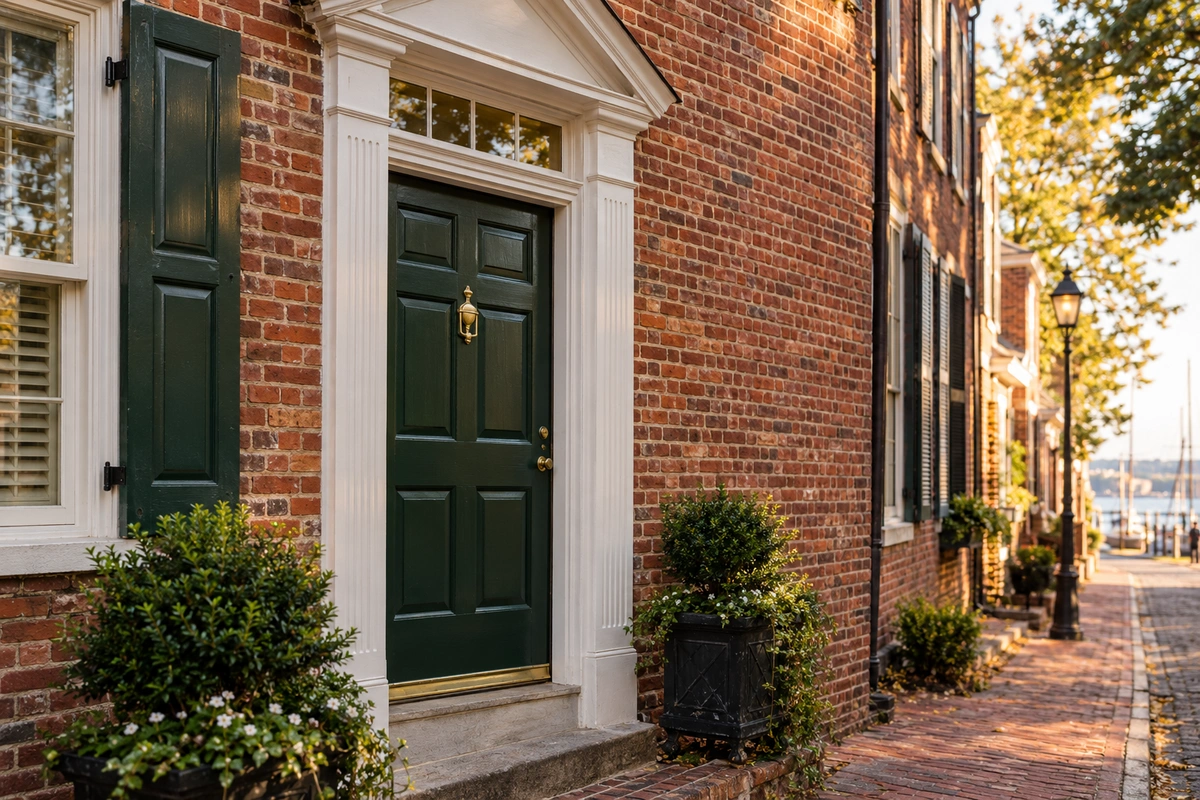
Why Annapolis Wood Doors Fail Faster Than Inland Maryland Doors
Most Maryland front doors face two enemies: summer humidity and winter freeze-thaw. An Annapolis door faces those plus a third, which is water arriving from below and from the side instead of only from the sky. Our Maryland door refinishing work statewide shows the pattern clearly. Identical mahogany doors installed in Bethesda and on the Annapolis waterfront age on very different clocks. The difference is almost entirely environmental, so every Annapolis assessment starts with three questions: how close the door sits to the water, which way it faces, and how much overhang protects it.
Tidal Flooding and Ground-Level Moisture Downtown
The city identifies its lowest-lying land as the City Dock area, including Compromise Street, and Second Street in Eastport, with nuisance flooding most common between March and September. In 2024, the deputy director of the city’s Office of Emergency Management said downtown was on track for about 120 flooding events that year, roughly one every three days at City Dock. Even when water never reaches a doorstep, saturated air and street-level splash soak the bottom rail and lower panels of nearby doors. End grain wicks that moisture upward and lifts the finish from the inside out. That is why we seal the bottom edge, top edge, and both stiles, the surfaces most painters never touch, as carefully as the visible face.
Salt Spray off the Severn, Spa Creek, and the Bay
Salt is the second accelerant. On breezy days, spray and salt-laden mist off the Severn and the open Bay leave fine crystals on exposed doors in Eastport, Wardour, Bay Ridge, and Hillsmere Shores. Those crystals draw moisture out of humid air and hold it against the finish. They also act as a mild abrasive every time the door is wiped. Over one or two seasons, a clear coat turns chalky, then hazy, then splits along the grain, while brass and bronze hardware pits alongside it. Our door care guides cover safe rinsing between refinishes. The matrix below shows where your door likely falls.
| Annapolis Area | Dominant Exposure | Typical Door Failure | Finish Strategy | Suggested Inspection |
|---|---|---|---|---|
| Historic District (Ward One, City Dock edge) | Tidal humidity, street-level splash, shallow rowhouse overhangs | Lifting finish on bottom rail, open panel joints, cracked glazing putty | Era-appropriate paint or stain, six-side sealing, glazing repair | Every 2–3 years |
| Eastport | Low elevation, Spa Creek and Back Creek salt air, boatyard grit | Chalking clear coat, pitted hardware | Marine-grade topcoats, hardware cleaning or replacement flag | Every 18–24 months |
| Murray Hill & West Annapolis | Humidity, mature shade trees, slow drying | Mildew staining, gray undertones, soft bottom edges | Mildew-focused prep, UV varnish in satin | Every 2–3 years |
| Wardour & Admiral Heights | Severn River and Weems Creek breezes, strong sun on open lots | Fading on south- and west-facing doors, surface checking | Extra UV-protective varnish build | Every 2 years |
| Annapolis Neck (Bay Ridge, Hillsmere Shores, Annapolis Roads) | Open-Bay wind, salt spray, intense morning sun | Rapid clear-coat breakdown, sidelight seal failure | Full marine-grade system, reinforced sidelight and threshold sealing | Every 18–24 months |
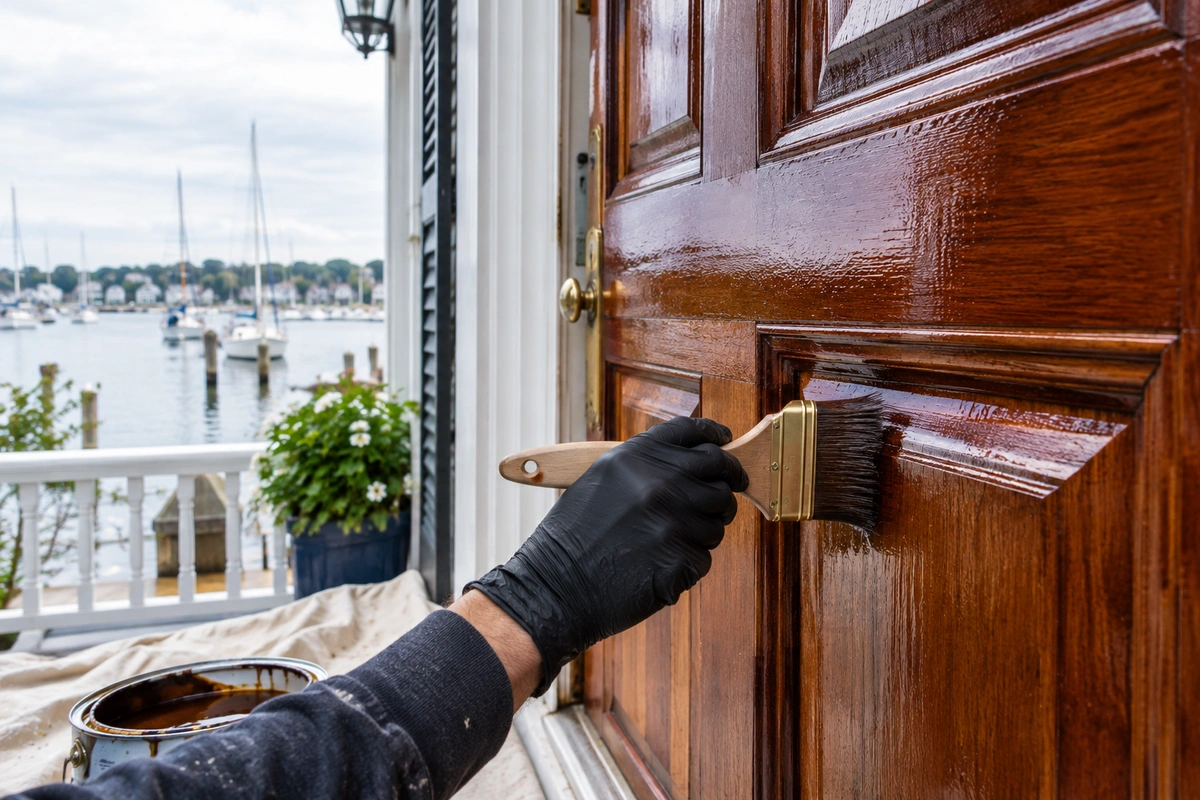
Historic Door Restoration in the Annapolis Historic District
The Annapolis Historic District was designated a National Historic Landmark District in 1965, joined the National Register the following year, and was expanded in 1984. Its historic core holds the country’s largest concentration of eighteenth-century brick buildings. Many front doors here are original or early replacements built from old-growth lumber that is denser and more stable than anything in a modern replacement unit. Once that door leaves the opening, it is gone for good. Restoration keeps the original joinery, glass, and hardware in place. We apply the same philosophy to historic door restoration in Old Town Alexandria and to downtown Frederick through our Frederick County door refinishing work.
Georgian, Federal, and Victorian Entries
A door’s style tells us how it was built and how it was meant to be finished. Many 18th-century Annapolis entries were painted, while Victorian doors often showed off varnished hardwood. We document the existing finish layers first. Then we recommend a finish appropriate to the door’s era instead of whatever stain happens to be popular this year. Because most historic paint layers predate 1978, federal lead-safe work rules apply when those layers are disturbed, and your assessment accounts for that.
| Era | Door Hallmarks | Common Problems | Our Approach |
|---|---|---|---|
| Georgian (c. 1700–1780) | Six-panel raised doors, rectangular transoms, pedimented surrounds | Heavy paint buildup, open panel joints, worn thresholds | Remove failing layers, repair joints, restore a traditional painted finish |
| Federal (c. 1780–1830) | Elliptical fanlights, slender sidelights, lighter moldings | Loose glazing, cracked muntins, bottom-rail rot | Glazing and muntin repair, structural wood repair, matched finish |
| Victorian (c. 1850–1900) | Tall double doors, glazed upper panels, heavy moldings | Faded varnish, UV-darkened wood, swelling and sticking | Strip to bare wood, color-matched stain, UV-protected varnish |
| Colonial Revival & early 20th century | Reproduction six-panel and Craftsman designs | Checked veneers, peeling clear coat | Veneer-safe sanding, stain matching, new clear-coat system |
Working Within Historic Preservation Commission Rules
Every exterior change to a structure in the local historic district requires Historic Preservation Commission approval, and certain properties also need sign-off from an easement holder such as Historic Annapolis. Restoring a door’s existing surface is generally treated as maintenance, not alteration. The city’s permit review guide lists painting as requiring no building permit, while replacing doors in kind requires HPC approval with a target review of five business days or less. The Commission’s design manual also notes that it does not review paint color. Switching a painted door to natural stain changes its appearance, so we recommend a quick check with HPC staff before that decision. Our before-and-after portfolio shows how restoration preserves original character.
| Work Type | City Review | What It Means for You |
|---|---|---|
| Refinishing or repainting the existing door | No building permit listed for painting; HPC does not review paint color | Routine restoration can usually proceed; check with HPC staff if the door’s appearance will change |
| Replacing the door in kind | HPC approval, target review of 5 business days or less | Refinishing avoids this step entirely |
| Changing door size or location | Building permit plus HPC approval | Not part of restoration work |
| Properties with a preservation easement | Easement holder approval may also be required | Review your easement terms before scheduling |
Front Door Refinishing Across Annapolis Neighborhoods
Annapolis looks compact on a map, but its neighborhoods differ sharply in housing age, construction quality, and exposure, and we adjust the scope for each one. Homeowners with family or a second property elsewhere in the region can rely on the same crew for door refinishing in Howard County and Prince George’s County door restoration.
Ward One and Murray Hill
Ward One is the historic core, where brick rowhouses and Georgian townhouses sit directly on the sidewalk with little overhang to shelter the door. Murray Hill, on the edge of the core, adds early-20th-century foursquares and Colonial Revival homes with deep porches and larger stained entries. Downtown work centers on joint repair, glazing, and era-correct finishes. Murray Hill projects more often involve stripping a failed clear coat and rebuilding a warm, hand-matched stain.
Eastport
Across the Spa Creek Bridge, Eastport mixes 19th-century watermen’s cottages, working boatyards, and newer waterfront townhomes. Low elevation, salt air from two creeks, and airborne grit from marine yards make this the hardest-working exposure inside city limits. Eastport doors get a full marine-grade topcoat system, six-side sealing, and a close look at hardware, which often corrodes faster than the wood around it.
West Annapolis, Wardour, and Admiral Heights
West Annapolis offers 1920s bungalows and mid-century homes under mature tree canopy, where shade slows drying and invites mildew. Wardour sits along the Severn, and Admiral Heights follows Weems Creek, so both combine river breezes with open, sunny lots. Sun-facing doors here fade and check first, and the fix is additional UV-protective varnish build rather than a heavier stain. Clients who split time between Annapolis and the capital beltway also use our Montgomery County door refinishing service.
Annapolis Neck: Hillsmere Shores, Bay Ridge, and Annapolis Roads
South of the city, Annapolis Neck faces the open Chesapeake and the South River. Homes here tend toward larger custom builds with mahogany double doors, wide glass sidelights, and full east-facing exposure to morning sun and Bay wind. These are the doors that most benefit from a complete marine-grade system and an 18–24-month inspection rhythm, because a small sidelight seal failure can let water behind the finish within a single season.
Our On-Site Exterior Door Staining and Refinishing Process in Annapolis
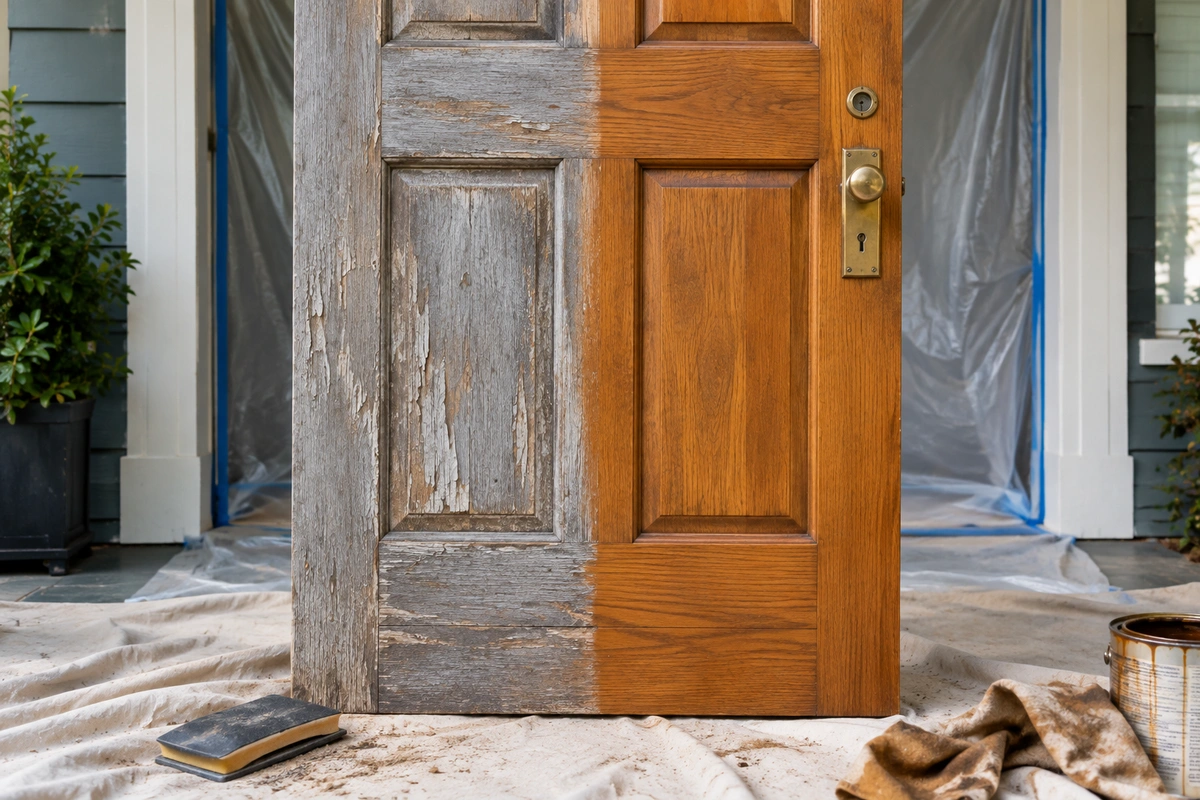
Every Annapolis project happens at your home, never in a distant shop. We take the door down on-site or work it in place, and we secure the opening with a temporary cover while the finish cures. Old paint and stain come off, the wood is sanded back to a clean surface, and cracks and imperfections are repaired before any color goes on. We then apply two coats of premium wood conditioner and three to five coats of stain, depending on the door. Our stain technique uses five different materials plus additional sanding to build the deep, thick-glaze finish our clients recognize. The door is then sealed with three coats of our UV-protected varnish in gloss or satin and rehung. The complete list of door refinishing services covers related work such as garage doors and repairs, and you can meet our refinishing crew before booking.
Timing the Work Around Annapolis Humidity
In a waterfront city, when each coat goes on matters as much as what goes on. We check the wood’s moisture before staining, avoid sealing a door that has absorbed overnight dampness, and schedule topcoats for the driest part of the day. On Eastport and Annapolis Neck jobs, we also plan around high tide and forecast wind, so salt mist is not settling onto wet varnish.
Choosing a Door Refinishing Company in Annapolis
Search for door help in Annapolis and most results come from handymen, painting contractors, and window-and-door replacement firms. Several of the most visible local door pages are built around installing new replacement units. That is a valid service, but it is the wrong starting point for a sound historic or hardwood door. The table below shows how the three approaches actually differ. Our door refinishing FAQ library answers the broader questions homeowners ask before hiring.
| Factor | Door Refinishing Specialist | General Painting Contractor | Replacement Door Company |
|---|---|---|---|
| Core focus | Wood door restoration and refinishing | Walls, trim, and siding; doors are a line item | Selling and installing new units |
| Original historic door | Preserved and restored | Usually painted over | Removed and discarded |
| Salt-air protection | Multi-coat stain plus three-coat UV varnish | Standard exterior paint or a single clear coat | Factory finish on the new door |
| Historic district path | Generally maintenance-level work | Generally maintenance-level work | In-kind replacement review required |
| Disruption | Typically 1–2 days on-site | Tied to the whole-house schedule | Order lead time plus installation |
Mahogany, Oak, Fiberglass, and Iron Doors We Restore
Annapolis entries span centuries of materials. Mahogany dominates waterfront custom homes, and heart pine and white oak appear in older downtown homes. Newer construction often uses fiberglass. For fiberglass, we refresh or re-grain the factory finish without cutting into the composite skin. Decorative iron entries get rust treatment and protective coatings, which matters in salt air. We also refinish wood garage and carriage-house doors, interior doors, and staircases. Downtown rowhouse owners will find our approach familiar if they have seen our front door refinishing in Washington DC, where similar brick rowhouse entries face similar street-level wear.
An Annapolis Door Maintenance Calendar
A refinished door lasts longest when small tasks happen at the right time of year. We also offer an annual maintenance application that renews protection before the finish breaks down. The calendar below reflects Annapolis conditions, and it is the same schedule we recommend for door refinishing across DC, Virginia and Maryland waterfront properties.
| Season | Annapolis Conditions | Door To-Do |
|---|---|---|
| Spring (Mar–May) | Nuisance-flood season begins, heavy pollen | Rinse off salt and pollen with mild soap; inspect bottom rail and threshold |
| Summer (Jun–Aug) | Peak humidity, strong UV, afternoon storms | Watch sun-facing doors for fading; vent storm doors so heat and moisture don’t build up |
| Early Fall (Sep–Oct) | Lower humidity, stable temperatures | Ideal window for full refinishing or the annual maintenance coat |
| Winter (Nov–Feb) | Freeze-thaw cycles, nor’easters, de-icing salt | Check weatherstripping; keep de-icer off wood thresholds |
What Clients Say About Door Refinishing Washington DC
Door Refinishing Washington DC holds a 5.0-star rating across 100+ Google reviews from homeowners throughout the region, from Capitol Hill to Chesapeake Bay communities and clients who book door refinishing in Virginia. These are verified reviews from our Google Business Profile.
“I was searching for the best door refinishing in DC to save my weathered entryway, and I’m so glad I found this team. They are hands-down the experts in wood door restoration. My front door staining looks incredible, the finish is smooth, durable, and completely transformed our home’s curb appeal.” — Hoordad Sharif, Local Guide ★★★★★
“I would 100% recommend! The experience of having our doors refinished was excellent, from start to finish. The response to my initial inquiry was quick, the quoting process was clear and fair, the craftsmen arrived on time… The cost of a set of new fiberglass doors was going to be astronomical, and after seeing our beautiful wood doors brought back to life, we know we made the right decision.” — Brooke Piercy ★★★★★
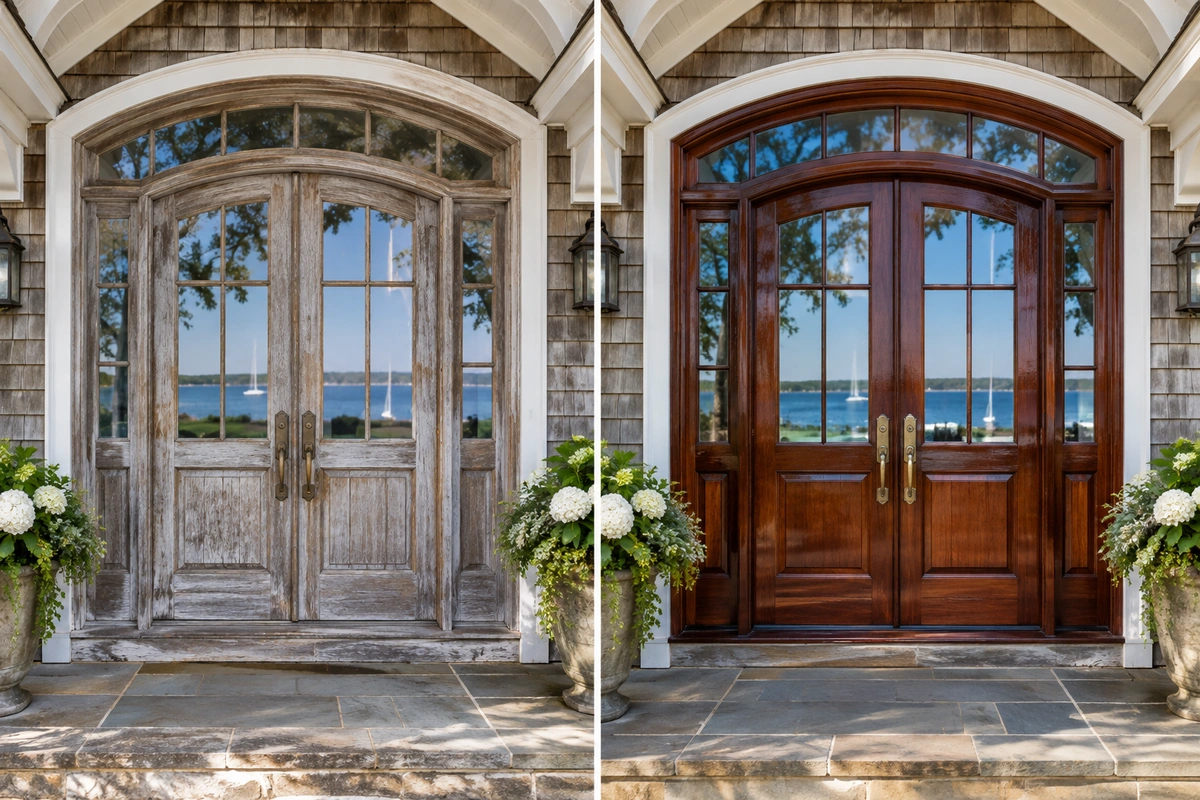
“DC Wood Door Refinishing Restoration did an awesome job refinishing our front and side doors after 12 years without any maintenance. The company was responsive and scheduled/finished the work quickly and with supreme quality. And the before and after photos really say it all!” — Jacey Spratt ★★★★★
Door Refinishing Annapolis MD FAQs
These answers address the questions Annapolis homeowners ask most often, especially about historic rules, flooding, and timing.
Do I need Historic Preservation Commission approval to refinish my front door in Annapolis?
Usually not for restoring the existing finish. The city’s permit guide lists painting without a building permit, and the HPC does not review paint color, while replacing a door requires HPC review. If you plan to change a painted door to natural stain, or your home carries a preservation easement, confirm with HPC staff or the easement holder first.
Can you match the original finish on a Georgian or Federal door?
Yes. We document the existing finish layers, then restore the door to a finish appropriate to its era. That means a traditional painted finish for many 18th-century entries, or a hand-matched stain and UV-protected varnish where the door was built to show its wood.
My Eastport home had water at the threshold. Can the door still be refinished?
Often, yes. If the rails and stiles are sound once dry, we repair damaged sections, seal the end grain and edges, and rebuild the finish. If the core is rotted, we will tell you plainly that replacement is the responsible choice.
When is the best time of year to refinish a door in Annapolis?
Early fall is ideal, because humidity drops and temperatures stay stable enough for proper curing. We work year-round, though, and schedule coats around daily humidity readings rather than the calendar.
Will my home be left open while the door is refinished?
No. Doors are refinished in place or taken down on-site, and the opening is secured with a temporary cover while coats cure. Your door never leaves your property.
Do you refinish boathouse, garage, and carriage-house doors near the water?
Yes. Wood garage and carriage-house doors on waterfront lots take the same salt and UV exposure as entry doors, so they receive the same multi-coat protective system.
Which Annapolis neighborhoods do you serve?
All of them, including the Historic District, Murray Hill, Eastport, West Annapolis, Wardour, Admiral Heights, Hillsmere Shores, Bay Ridge, and Annapolis Roads, plus nearby Broadneck communities.
How do I get an accurate quote before an in-person visit?
Upload two or three photos through the form below: one straight-on, one close-up of the bottom rail, and one of the hardware. We review them and follow up by phone or text with next steps.
Get Your Free Door Refinishing Quote in Annapolis MD
Ready to restore your door instead of replacing it? Send a few photos and your neighborhood, and we will come back with a clear recommendation for door refinishing in Annapolis MD, whether your door needs a maintenance coat, a full strip-and-refinish, or an honest conversation about replacement. You can also call, text, or use our contact page.
DC Wood Door Refinishing Restoration
1240 3rd St NE Unit 535, Washington, DC 20002 (on-site service throughout Annapolis)
📞 +1 (571) 500-9876 · 💬 Text for an instant quote