Door Refinishing in Howard County, MD
Expert wood door restoration and front door refinishing services. Serving Columbia, Ellicott City, Elkridge, and Clarksville with premium finishes designed to withstand Maryland’s humid summers and freeze-thaw winters.
Serving all of Howard County. Fast, local response.

DC.DoorStain Team
Senior Door Refinishing Specialists · Howard County Service Area
⏱ 9 min read · Published August 2026
Howard County’s wood front doors carry a lot of history and a lot of weather. Between Columbia’s dense tree canopy and Ellicott City’s 250-year-old stone rowhouses along the Patapsco, the county’s entry doors take on humidity, direct sun, and winter freeze-thaw cycling in roughly equal measure — and most of them show it. DC DoorStain provides on-site door refinishing in Howard County, MD, restoring wood, fiberglass, and historic front doors across Columbia, Ellicott City, Elkridge, Clarksville, and the surrounding communities without the cost or waste of a full replacement. Every project is hand-sanded, stained, and sealed in place, using the same crew and materials trusted throughout the greater Washington DC metro area.
Homeowners searching for a specialist rather than a generalist have a real gap to work with here. Howard County’s current search results are dominated by hardwood floor refinishers, garage door repair franchises, cabinet painters, and HomeAdvisor lead-matching pages — none of which focus specifically on wood front door restoration. That gap is exactly what this page, and the crew behind it, is built to close.
It’s also a gap that costs homeowners money when it goes unaddressed. A door that gets replaced instead of refinished because no specialist was found nearby typically costs several times more than a professional refinish, on top of losing whatever original material, proportions, or historic character the door carried. For a county with as much older housing stock as Howard County has, that’s not a small consideration.
Serving Columbia, Ellicott City & All of Howard County
Howard County sits in a distinctive position inside the Baltimore–Washington corridor: close enough to DC that a growing share of residents commute south, but historically and architecturally tied to Baltimore’s colonial and Victorian building stock. That mix shows up directly in the housing — Columbia’s mid-century planned-community colonials and split-levels sit a few miles from Ellicott City’s stacked stone rowhouses and 18th-century farmhouses, and each building type puts different demands on a front door.
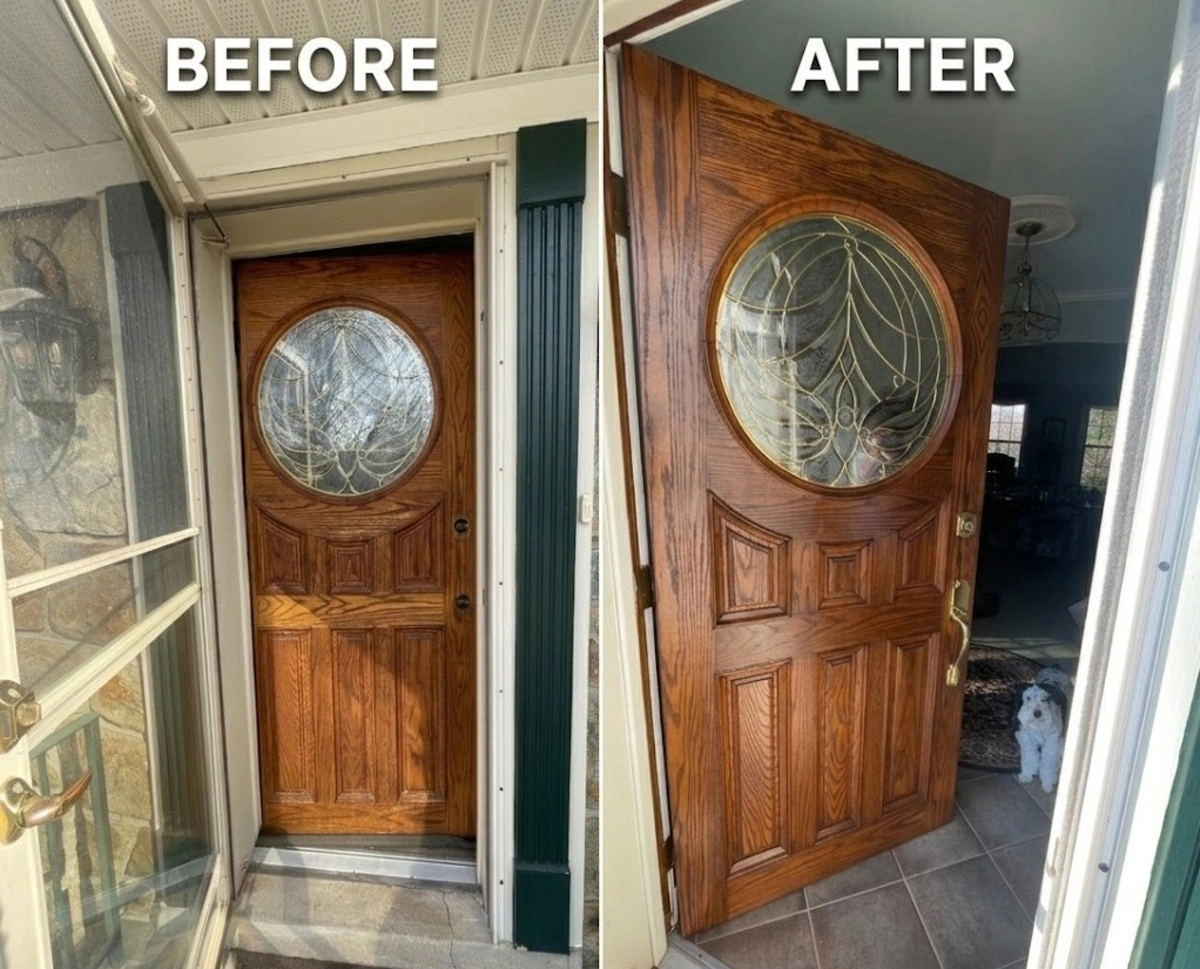
DC DoorStain’s Howard County service area covers Columbia’s ten villages (Town Center, Wilde Lake, Oakland Mills, Long Reach, Owen Brown, Hickory Ridge, Kings Contrivance, Harper’s Choice, River Hill, and Dorsey’s Search), the Ellicott City historic district and surrounding neighborhoods, Elkridge, Clarksville, and Fulton. Because the crew already services Montgomery County door refinishing and Prince George’s County wood door restoration on a regular route, Howard County fits directly into the existing Maryland scheduling loop rather than requiring a separate crew or travel surcharge.
Neighborhood-by-Neighborhood: Door Refinishing Across Columbia’s Villages
Columbia’s planned-community design means each of its ten villages has its own distinct housing stock, built in waves from the late 1960s through the 2000s, which changes what a typical refinishing project actually involves from one village to the next. Wilde Lake and Harper’s Choice, among the earliest built, tend to have original mid-century solid wood doors that have likely never been professionally refinished and often show the deepest UV and moisture damage. Town Center and Kings Contrivance carry a mix of townhome and single-family stock with a higher proportion of fiberglass entries installed during 1990s and 2000s renovations. River Hill and Dorsey’s Search, developed later and generally at a higher price point, more frequently feature custom wood doors with decorative glass or sidelights that require additional masking care during the sanding and staining process.
This variation is part of why DC DoorStain quotes each Howard County project individually rather than offering a flat county-wide price — a Wilde Lake original wood door in need of full stripping is a meaningfully different scope than a ten-year-old fiberglass entry in Kings Contrivance that just needs a fresh top coat.
Why Howard County’s Humid Summers and Freeze-Thaw Winters Damage Wood Doors
A wood door doesn’t fail because it’s old — it fails because nobody addressed the finish before moisture got underneath it. Howard County’s climate makes that failure mode almost inevitable without regular maintenance, because the county cycles between two extremes that both attack a door’s finish from opposite directions.
Humidity, Rainfall & UV Exposure in Columbia and Ellicott City
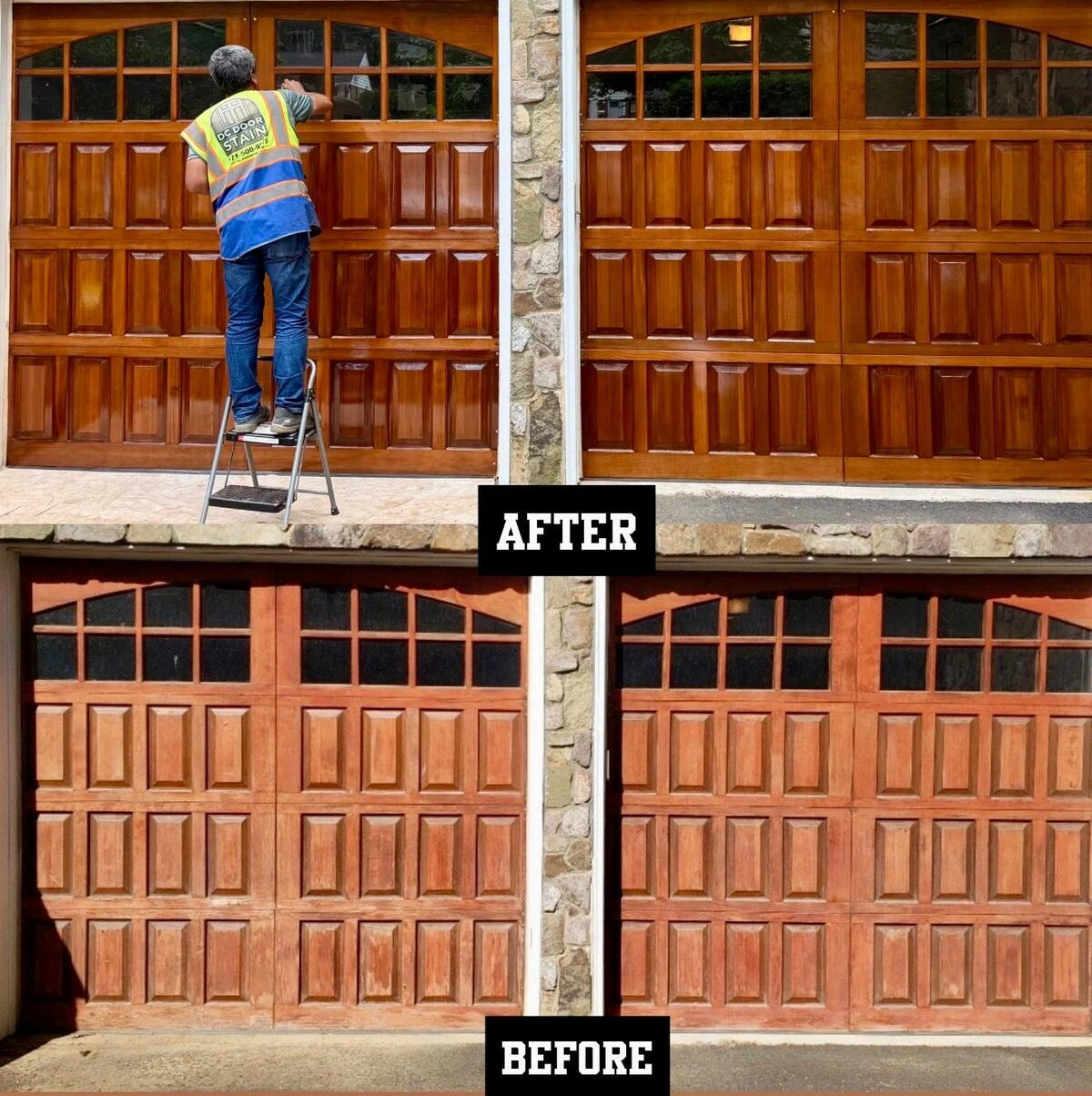
Howard County carries a humid subtropical classification, with relative humidity averaging between 72% and 77% year-round and no true dry season. Rainfall is spread across the calendar rather than concentrated in a single wet season, and the county sees a steady increase from roughly 1.85 inches of rain in January to over 4 inches in August, with rainy days climbing alongside it. That combination — near-constant humidity plus frequent rain — is what drives moisture into any hairline crack in a door’s clear coat or paint film, where it swells the wood grain, lifts the finish, and eventually causes the graying and splitting that homeowners mistake for a door needing full replacement. Layer on summers that run warm and humid with strong UV exposure on south- and west-facing entries, and even a high-quality factory finish breaks down inside five to seven years without recoating.
Freeze-Thaw Cycles and Historic Wood Doors
Winter brings the opposite stress. Ellicott City winters run very cold, snowy, and windy, with temperatures typically ranging from 27°F to 87°F over the course of the year, which means the county’s wood doors move through dozens of freeze-thaw cycles each season. Moisture that soaked into unsealed wood grain during a wet fall afternoon expands as ice, forcing the wood fibers apart from the inside — a process that’s especially damaging to the older, tighter-grained wood species used in Ellicott City’s 19th-century doors, where original material can’t simply be swapped out without losing the house’s character. Refinishing that resets the seal before winter is the single most effective way to interrupt this cycle before it turns into structural cracking or rot at the door’s base and panel joints.
Between the humidity load and the freeze-thaw stress, Howard County doors typically need a full strip-and-refinish cycle every four to six years for south- or west-facing exterior doors, and every seven to ten years for sheltered or north-facing entries — noticeably more often than the same door would need in a drier, more temperate climate.
Our Wood Door Refinishing Process
DC DoorStain’s process is built around one core principle: the door stays on its hinges. There’s no removal, no replacement lead time, and no gap in your home’s security while the work happens. A typical Howard County refinishing project runs one to two days depending on the door’s condition and whether both sides need attention.
On-Site Sanding, Staining & Sealing
Every project starts with an on-site assessment of the door’s material, existing finish, and damage — checking specifically for the swelling, checking, and UV graying patterns typical of Howard County’s climate. The crew masks surrounding hardware and glass, hand- and machine-sands down to bare or stable substrate, and repairs any minor checking or gouging before staining. Stain is applied in the color the homeowner selects — including historically accurate tones for Ellicott City properties — followed by multiple coats of a UV-resistant marine-grade or spar urethane sealant built to handle the humidity and temperature swings described above. The entire process happens outside your door, not in a shop, which is part of why turnaround stays fast even during Howard County’s busy spring and fall renovation seasons.
Materials We Work With: Wood, Fiberglass & Historic Doors
While solid wood doors are the specialty, the same on-site process applies to stainable fiberglass entry doors — common in Columbia’s newer construction — and to the reproduction and original wood doors found throughout Ellicott City’s historic district. Historic doors get additional care: matching original stain profiles, working around existing hardware the homeowner wants preserved, and using finish products compatible with the substrate condition of century-old wood. Garage doors, storm doors, and interior doors are refinished using the same on-site methodology when requested as part of a larger project.
Mahogany, oak, fir, and knotty alder are the species most commonly encountered on Howard County exterior doors, and each behaves differently under a strip-and-refinish process. Mahogany and oak hold gel stains evenly and tend to be the easiest to restore to a like-new appearance, which is one reason they show up so frequently in both Columbia’s builder-grade doors and the higher-end custom entries found in River Hill and Clarksville. Fir and knotty alder, more common on older Ellicott City and Elkridge properties, are softer and more prone to denting and UV graying, so they typically need a more conservative sanding pass to avoid removing too much material from an already-thin door face. Identifying the species correctly during the initial assessment is part of what keeps a Howard County refinishing project from turning into an unplanned repair.
What to Expect on Refinishing Day
Most homeowners’ only real logistical question is whether they’ll be without a functioning front door during the project — they won’t be. The crew works one door at a time, keeping it hung and functional between coats, and typically completes masking and initial sanding within the first two to three hours on-site. Because Howard County’s humidity can slow drying time compared to a drier climate, the schedule usually builds in slightly longer intervals between coats than a project in, say, Loudoun County would need; this is accounted for automatically in the quoted timeline rather than treated as a delay. Homeowners are given a same-day walkthrough at the end of each visit and a clear expectation for when the final coat will be fully cured and safe for normal daily use, hardware reinstallation, and weather exposure.
| Factor | Door Refinishing | Full Door Replacement | Howard County Consideration |
|---|---|---|---|
| Typical Cost | A fraction of replacement cost | Significantly higher, plus installation labor | Replacement cost climbs further for custom sizes common in Ellicott City’s older homes |
| Timeline | 1–2 days, on-site | Days to weeks for special-order sizing | Historic openings rarely match modern standard sizes |
| Historic Character | Preserves original wood, hardware, and proportions | Original material lost permanently | Relevant to Ellicott City’s National Register-listed homes |
| Climate Durability | New UV-resistant, humidity-rated sealant applied | Depends on new unit’s factory finish | Either option needs Howard County-appropriate sealants to handle 72–77% average humidity |
| Environmental Impact | No landfill waste, no new material sourcing | Old door discarded; new materials manufactured | Growing preference among Columbia’s sustainability-minded homeowners |
Historic Preservation in Ellicott City & Doughoregan Manor Country
Howard County’s historic building stock gives this market a character the rest of the DC metro doesn’t fully share. Ellicott City was founded in 1772 and its historic district centers on a charming main street, with wood entry doors on rowhouses and merchant buildings that predate the Civil War. Nearby Doughoregan Manor, built in 1766, was the country home of Declaration of Independence signer Charles Carroll and remains in the family today — a reminder that this county’s oldest wood doors aren’t incidental architectural details, they’re artifacts.
That context changes how a refinishing project should be approached. A door on a 1960s Columbia split-level can be sanded aggressively and refinished in a contemporary stain without any real risk. A door on an Ellicott City rowhouse from the 1800s needs a gentler hand, stain-matching against surviving original sections, and hardware handling that respects whatever original ironwork is still attached. DC DoorStain treats these as two different jobs even though the underlying service — historic wood door restoration — is the same discipline applied with different intensity. Homeowners in the historic district, or on any of the county’s National Register-listed properties, should mention the property’s age at the time of quoting so the crew can plan the appropriate approach.
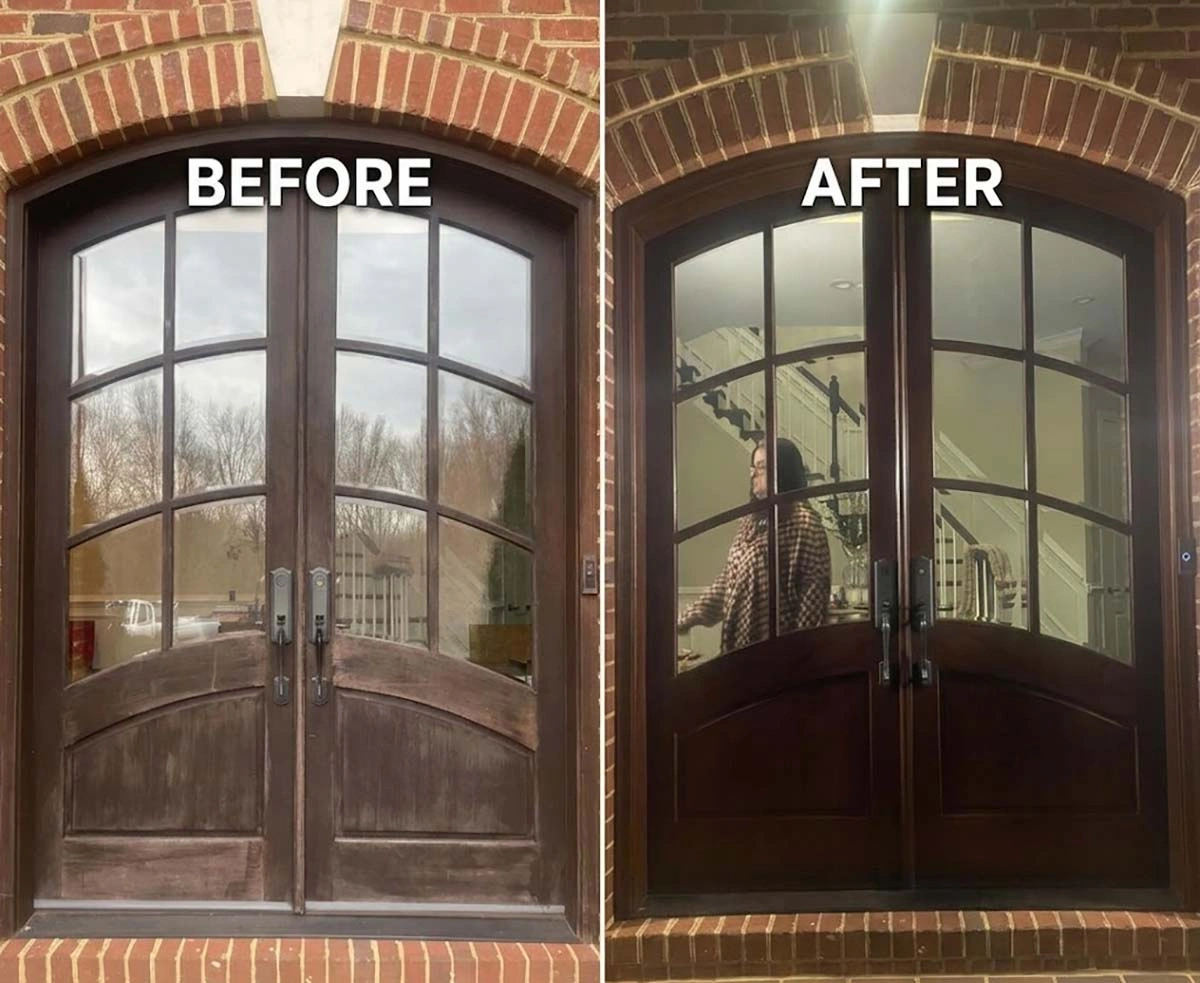
Beyond Main Street itself, Howard County carries a surprising density of historic homes for homeowners to be aware of, including several other National Register-listed properties scattered through the Ellicott City and Route 108 corridors — 19th-century farmhouses, Victorian-era country estates, and mill-worker cottages built alongside the Patapsco’s historic textile industry. Many of these properties still carry their original entry doors, softwood construction that’s now well over a century old and correspondingly fragile under aggressive power-sanding. For these homes, the refinishing approach leans more heavily on hand-scraping and chemical stripping over mechanical sanding, preserving as much of the original wood surface as possible while still achieving a durable, weather-resistant final finish. Homeowners restoring a documented historic property for insurance, appraisal, or county preservation-commission purposes can request before-and-after photo documentation as part of the project.
Choosing a Stain Color for Your Howard County Home
Stain color is one of the few genuinely personal decisions in a refinishing project, and it’s worth treating deliberately rather than defaulting to whatever shade the door happens to already be. Columbia’s brick colonials and Cape Cods tend to pair well with warmer tones — mahogany, provincial, or early American — that complement red and tan brick without competing with it. Ellicott City’s stone and stucco rowhouses lean toward darker, more saturated tones like ebony or dark walnut, which historically was the more common choice for 19th-century Maryland millwork and reads as more authentic against stone. Newer construction in Fulton and River Hill has more flexibility, since these homes weren’t built around a specific historic palette, and homeowners there frequently choose lighter driftwood or natural oak tones to match contemporary exterior trim.
Whatever the starting preference, a physical sample applied directly to the door — not a swatch viewed indoors under artificial light — is standard practice before committing to a full refinish, since Howard County’s tree cover and seasonal light changes can shift how a stain reads throughout the year.
How Howard County Compares to Other DMV Door Refinishing Providers
Searching “door refinishing near me” from a Columbia or Ellicott City address currently surfaces almost no specialist competition. The gap breaks down as follows:
| Provider Type Found in Search | What They Actually Do | Gap for Howard County Homeowners |
|---|---|---|
| Hardwood floor refinishers | Sand and refinish interior flooring | Not equipped or licensed for exterior door finishing systems |
| Garage door repair franchises | Mechanical repair, opener installation, panel replacement | No wood refinishing or staining service offered |
| General handyman / HomeAdvisor matches | Broad home repair, lead-generation matching | No door-refinishing specialization or climate-specific process |
| Cabinet painting companies | Interior cabinetry refinishing | Different substrate, different exterior-grade finish requirements |
| DC DoorStain | On-site wood, fiberglass, and historic door refinishing, DC/VA/MD-wide | Fills the specialist gap directly, with Howard County-specific climate and historic-preservation expertise |
What Our Howard County Customers Say
DC DoorStain’s reputation across the DC metro carries directly into Howard County, backed by a 4.9-star average across 100 verified Google reviews.
“I was searching for the best door refinishing in DC to save my weathered entryway, and I’m so glad I found this team. My front door staining looks incredible, the finish is smooth, durable, and completely transformed our home’s curb appeal. If you’re looking for ‘door refinishing near me’ in Northern Virginia or Maryland, don’t hesitate.” — Hoordad Sharif, Local Guide, 22 reviews
“I would 100% recommend! The response to my initial inquiry was quick, the quoting process was clear and fair, the craftsmen arrived on time, and the work was done with care and attention to detail. The cost of a set of new fiberglass doors was going to be astronomical, and after seeing our beautiful wood doors brought back to life, we know we made the right decision.” — Brooke Piercy
“DC Wood Door Refinishing Restoration did an awesome job refinishing our front and side doors after 12 years without any maintenance. The company was responsive and scheduled/finished the work quickly and with supreme quality.” — Jacey Spratt
Read more verified customer reviews before requesting your Howard County quote.
Frequently Asked Questions
How much does door refinishing cost in Howard County, MD?
Cost depends on the door’s size, material, current condition, and whether both sides need work, but refinishing consistently runs a fraction of full replacement cost — request a free on-site quote for an exact figure.
How long does a wood door refinishing project take in Columbia or Ellicott City?
Most single-door projects are completed in one to two days on-site, with the door usable again shortly after each coat cures.
Can you refinish a historic wood door in Ellicott City’s historic district?
Yes. Historic doors are assessed individually for original wood condition, stain-matching, and existing hardware, and are handled with a gentler process than standard modern doors.
Do you refinish fiberglass front doors too?
Yes. Stainable fiberglass entry doors, common in newer Columbia construction, are refinished on-site using the same staining and sealing process.
Will refinishing hold up to Howard County’s humidity?
Yes. The sealant systems used are UV-resistant and rated for the sustained 72–77% average humidity typical of the Columbia and Ellicott City area.
Does the door need to be removed from its hinges?
No. Every DC DoorStain project is completed on-site with the door in place.
How often should a Howard County front door be refinished?
South- and west-facing doors with direct sun exposure typically need refinishing every four to six years; sheltered or north-facing doors can go seven to ten years between projects.
What areas of Howard County do you serve?
All of Columbia’s ten villages, Ellicott City, Elkridge, Clarksville, and Fulton, on the same route as our existing Montgomery County and Prince George’s County service.
What’s included in a free quote?
An on-site or photo-based assessment of the door’s material and condition, a firm price, and a recommended timeline — with no obligation to book.
Can I choose the stain color?
Yes. Homeowners select the stain shade, including historically accurate color-matching for older Ellicott City properties.
Get Your Free Howard County Door Refinishing Quote
Request a free, no-obligation quote from DC DoorStain’s wood door refinishing experts — upload a photo of your door below and a project specialist will follow up with pricing and a recommended timeline.