
Door Refinishing in Richmond, Virginia
Expert wood door restoration and front door refinishing for Church Hill, the Fan District, the Museum District, and Jackson Ward. On-site, historic-district-aware craftsmanship built for Richmond’s four-season climate.
Request Your Free Richmond Quote
Serving Church Hill, the Fan District, Museum District & Jackson Ward. Fast, local response.

Door Refinishing Washington DC Team
Senior Door Refinishing Specialists · Richmond, VA
⏱ 13 min read
Richmond’s wood door stock spans nearly 300 years, from Federal-era originals near St. John’s Church to Victorian rowhouse entries across the Fan District — and almost none of it needs to be replaced rather than refinished. This page answers the questions Richmond homeowners actually ask, in the order they tend to ask them: what door refinishing means, which neighborhoods need which approach, why Richmond’s climate is a genuinely different challenge than a warm-coastal market, and what the process and historic-district rules actually look like in practice. Richmond joins the same DC, Virginia & Maryland service area this team already covers, bringing the identical on-site process south from Fairfax County door refinishing and Old Town Alexandria door refinishing into central Virginia.
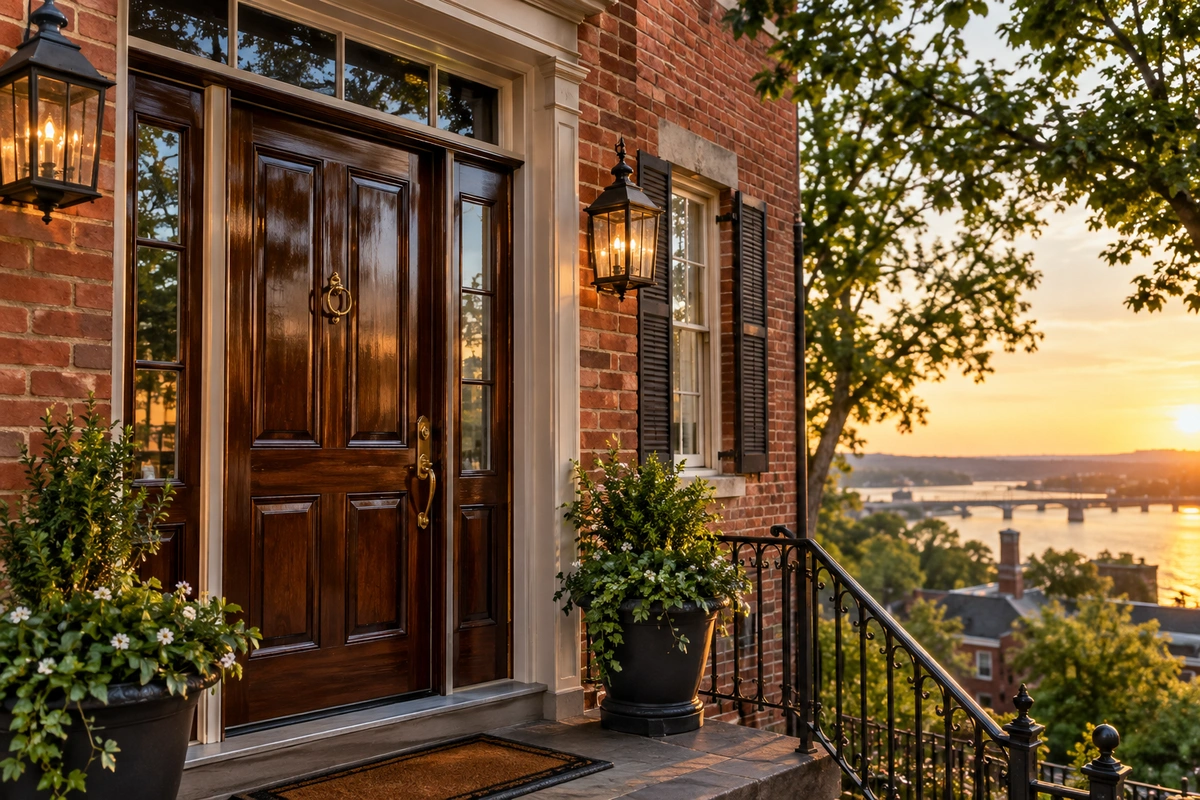
Door Refinishing Washington DC provides on-site wood door refinishing and restoration in Richmond, Virginia, including Church Hill, the Fan District, the Museum District, and Jackson Ward. The team strips, repairs, stains, and seals exterior and interior wood doors without removing them from their frames, using a five-material stain process and UV-protected varnish built for Virginia’s four-season climate. Most single-door projects finish in one to two days. The company is rated 5.0 out of 5 across 100 Google reviews and is reachable at (571) 500-9876.
Key Facts at a Glance
| Question | Answer |
|---|---|
| Who provides door refinishing in Richmond, VA? | Door Refinishing Washington DC (DC Wood Door Refinishing Restoration), a Carpenter-category business rated 5.0★ on 100 Google reviews. |
| Is the service on-site? | Yes — doors are refinished in place, without removal from the frame. |
| How long does a typical project take? | Most single-door projects complete in 1–2 days; heavier restoration may take longer. |
| What neighborhoods are covered? | Church Hill, The Fan District, Museum District/Monument Avenue, Jackson Ward, and surrounding Richmond neighborhoods. |
| Does the company work in historic districts? | Yes — including Richmond’s Old and Historic Districts subject to Commission of Architectural Review (CAR) guidelines. |
| How do I get a quote? | Call (571) 500-9876 or submit a photo-based quote request online — no obligation. |
What “Door Refinishing” Actually Means
These four terms get used interchangeably, but they describe different scopes of work — and knowing which one you actually need affects both cost and timeline.
| Term | What It Means | How It Differs |
|---|---|---|
| Door Refinishing | Stripping the existing finish down to bare wood, repairing minor surface damage, and applying new stain and sealant. | No structural work. The door itself is sound; only the finish has failed. |
| Door Restoration | Refinishing plus structural repair — fixing rot, cracked panels, or loose joints before refinishing begins. | Involves carpentry work in addition to finishing. Often what an “antique door” project actually needs. |
| Door Repair | Targeted fixes — a cracked panel, a failing hinge, weatherstripping — without a full strip-and-refinish. | Narrower in scope than restoration; doesn’t necessarily touch the finish at all. |
| Door Replacement | Removing the original door and installing a new one. | The only option when a door is too structurally compromised to save — rare, even for century-old doors. |
Most Richmond doors that look “beyond saving” from the street — chalky finish, dark water staining, a sticking bottom rail — are refinishing or restoration candidates, not replacement candidates. Our full range of door and wood restoration services covers all four categories above, and the initial on-site assessment is what determines which one your door actually needs.
Richmond Neighborhood Door Profile
| Neighborhood | Typical Era | Common Door Style | Historic Review Likely? |
|---|---|---|---|
| Church Hill | Early 1800s–1900s | Federal and Victorian paneled entries, often with sidelights and transoms | Yes — Richmond’s first designated Old and Historic District (1957) |
| The Fan District | 1890s–1920s | Victorian rowhouse doors along tree-lined, fan-shaped streets | Yes — much of the Fan sits within a designated Old and Historic District |
| Museum District / Monument Avenue | Early 20th century | Colonial Revival and Georgian Revival entries on a National Historic Landmark boulevard | Often, depending on the specific block |
| Jackson Ward | 1800s–early 1900s | Row house entries reflecting one of the country’s most historically significant African American commercial and residential districts | Yes — designated historic district |
Church Hill deserves a specific callout: it’s Richmond’s oldest surviving residential neighborhood, built around St. John’s Church — completed in 1741 and the site of Patrick Henry’s 1775 “Give me liberty, or give me death” speech. Homes here range from Federal-era originals to Victorian infill built as the neighborhood grew across the 19th century, and the doors reflect that full span. A door refinisher working in Church Hill needs to recognize the difference between a Federal-period panel door and a later Victorian one on sight, since they call for different color palettes and hardware treatment.
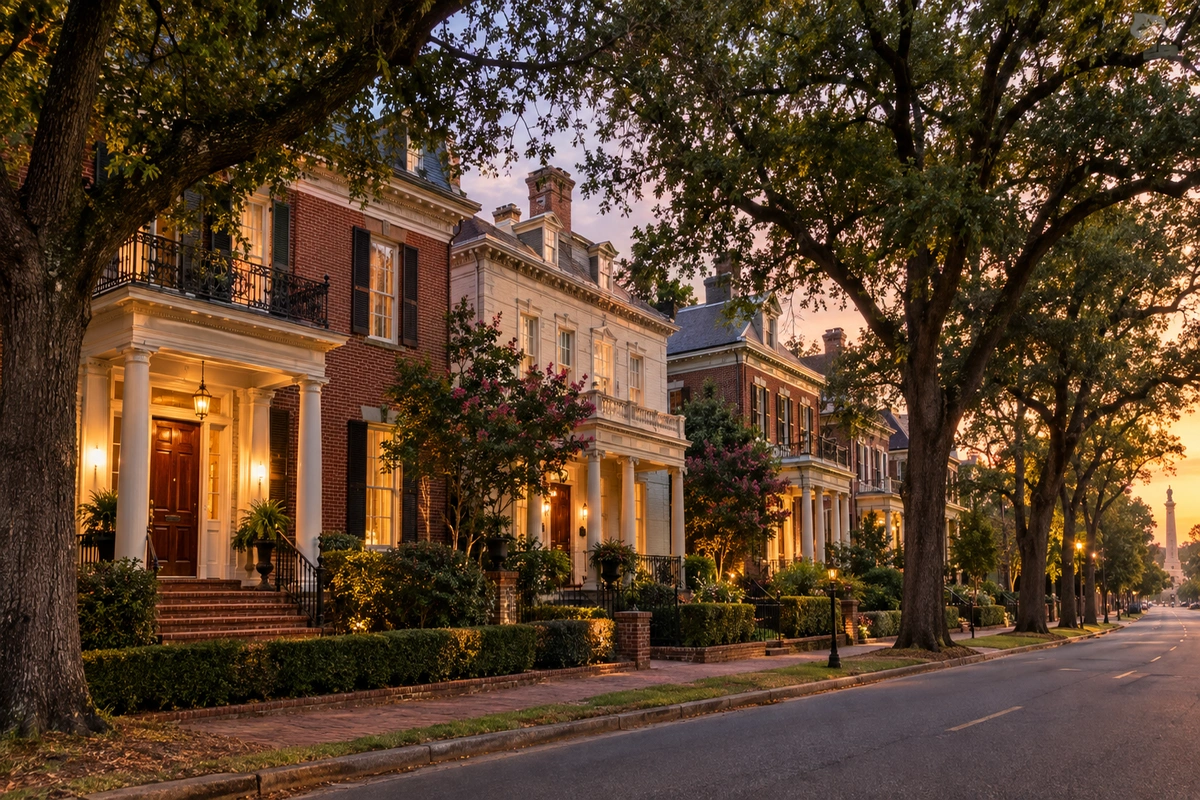
The Fan District tells a different story: it’s a single, cohesive Victorian-era development rather than a neighborhood that accumulated over centuries, laid out in the fan-shaped street pattern radiating from Monroe Park that gives it its name. Because most of the Fan’s rowhouses went up within a few decades of each other, the doors here are more architecturally consistent than Church Hill’s — mostly late-19th and early-20th-century paneled entries — which makes period-correct color matching more straightforward but no less important, since the Fan’s Old and Historic District designation covers much of the neighborhood’s core blocks. The same historic-district judgment call comes up further north in our Arlington door refinishing work in Clarendon and Courthouse, where a very different architectural era raises a similar design-review question.
Why Richmond’s Climate Is Harder on Doors Than People Expect
Short answer: Richmond gets genuine winter freezes on top of Mid-Atlantic summer humidity, and that combination stresses a wood door more than either condition alone would. Unlike a purely warm-climate market, a Richmond door has to survive:
- Summer humidity and UV — James River humidity plus long, hot summers break down finish the same way it does across the Mid-Atlantic.
- Freeze-thaw cycling — winter temperatures that dip below freezing cause moisture trapped in wood or an aging finish to expand and contract, which is what actually causes a lot of the fine cracking seen on older Church Hill and Fan doors.
- Four distinct seasons of expansion and contraction — a door here swells in humid summer and contracts in dry winter cold every single year, which is a different stress pattern than a door in a climate that stays warm and humid year-round.
- Storm exposure — Mid-Atlantic thunderstorms and the occasional remnant tropical system bring wind-driven rain that finds gaps in old weatherstripping.
This is also why a finish formulated for a warm coastal market doesn’t necessarily perform the same way in Richmond — the sealant needs enough flexibility to handle a real freeze-thaw cycle, not just heat and humidity. It’s a different profile than what we see in our Washington DC door refinishing and Maryland door refinishing work, where winters along the I-95 corridor tend to run milder than central Virginia’s.
Materials & Methods Built for Richmond’s Four-Season Climate
Richmond doors call for a different materials approach than the single-climate markets we work in elsewhere, because the wood itself experiences a full expansion-and-contraction cycle every year rather than sitting in one exposure condition year-round. We use the same five-material stain application and additional hand-sanding process that’s our signature everywhere, but the conditioning step matters more here: heart pine and cypress, both common in Church Hill’s older stock, need a conditioner that controls stain absorption evenly across wood that has already been through decades of seasonal swelling and shrinking.
| Condition | Typical Exposure in Richmond | Effect on Wood Doors | How We Address It |
|---|---|---|---|
| Summer humidity & UV | High, June through September | Wood swelling, finish delamination, stain fading | Full strip to bare wood, moisture-appropriate conditioner, UV-protected topcoat |
| Winter freeze-thaw cycling | Regular sub-freezing temperatures, December through February | Fine cracking in older finishes as trapped moisture expands and contracts | Flexible, multi-coat varnish system rather than a single rigid topcoat |
| Spring and fall seasonal swing | Year-round, most pronounced during transition months | Continuous wood expansion and contraction stresses joints and finish adhesion | Conditioning step calibrated to the wood’s existing moisture history |
| Storm-driven rain | Spring and summer thunderstorms, occasional tropical remnants | Wind-driven moisture finds gaps in aging weatherstripping | Weatherstripping and threshold seal checked as part of every reinstallation |
For doors with heavier sun exposure — south- or west-facing entries common along the Fan District’s grid streets — we lean toward a slightly more UV-resistant topcoat formulation than a shaded, north-facing Church Hill entry would need. That distinction gets made during the on-site assessment, not applied as a blanket default. It’s the same principle behind how we adjust topcoat choice for sun-drenched new-construction entries in our Loudoun County door refinishing and Montgomery County door refinishing work — just applied here to century-old wood instead of new millwork.
Maintaining Your Refinished Door Through Richmond’s Seasons
A properly refinished door holds up for years, but the gap between a door that needs attention every two years and one that goes the full five almost always comes down to maintenance rather than the initial finish quality. Richmond’s seasonal swing means the right maintenance check happens twice a year rather than once: a fall inspection before winter freeze-thaw cycling starts, and a spring inspection after it ends.
Look for dulling sheen, hairline cracks in the varnish, or any softness near the bottom rail where snowmelt or spring rain tends to collect. Wiping the door down periodically and keeping to the maintenance-coat schedule your finish calls for both extend the interval between full refinishing cycles — and catching a small crack before a Richmond winter starts is far less work than addressing full finish failure once freeze-thaw has already gotten into it.
Historic District Approval: What Church Hill and the Fan Actually Require
refinishing an existing door in a Richmond Old and Historic District generally doesn’t require Commission of Architectural Review (CAR) approval, but replacing one usually does. Richmond’s Old and Historic Districts — including Church Hill and much of the Fan — fall under design review for exterior changes, and swapping an original door for a new one is the kind of change that typically needs CAR sign-off. Refinishing the door you already have sidesteps that process entirely, since you’re restoring the original rather than proposing a new design for the commission to evaluate. If you’re weighing refinishing against replacement on a designated property, that’s often the deciding factor on its own, independent of cost.
That said, the specifics vary by district and by the scope of work involved, and we’re not a substitute for confirming requirements with the city directly on any project beyond a straightforward refinish. What we can say with confidence, based on years of work in these neighborhoods, is that the overwhelming majority of Church Hill and Fan District projects we take on are refinishing or restoration jobs precisely because homeowners want to avoid the review process a replacement would trigger — not because the review itself is unreasonable, but because refinishing is simply the faster, less disruptive path to the same result.
How On-Site Door Refinishing Works
- Assessment. We evaluate the door’s wood species, era, and condition on-site, and identify whether it needs refinishing, restoration, or targeted repair.
- Protection setup. The door is unhinged and the entrance is secured with a temporary weatherproof cover.
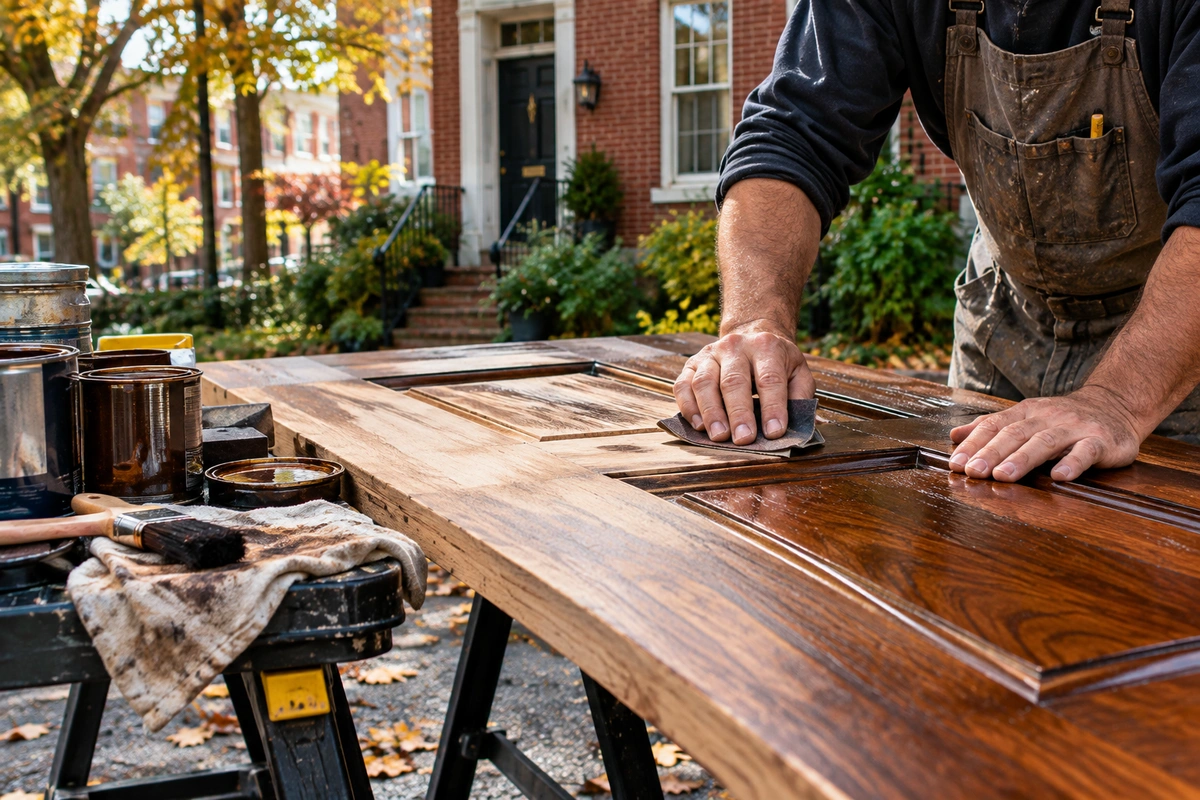
- Stripping. Old paint, stain, and failed sealant are stripped down to bare wood.
- Repair. Cracks, rot, or loose joints are repaired before any finish is applied.
- Conditioning. Two coats of conditioner prepare the wood to absorb stain evenly.
- Staining. Three to five coats of stain are applied depending on the door’s density and desired color depth.
- Sealing. Three coats of UV-protected varnish, glossy or satin, are applied and cured.
- Reinstallation. The door is rehung, and hardware and weatherstripping are checked for a proper seal.
Most single-door projects complete in one to two days. Our About page covers the 15-plus years of experience behind this process.
Refinishing vs. Replacing: Myth vs. Fact
| Myth | Fact |
|---|---|
| “If a door looks this bad, it has to be replaced.” | Most doors that look severely faded, chalky, or water-stained are cosmetic problems, not structural ones, and refinishing resolves them. |
| “Refinishing is a short-term fix; replacement lasts longer.” | A properly refinished solid wood door, maintained on schedule, can outlast a lower-grade replacement door — and preserves original joinery a modern door can’t replicate. |
| “Historic doors always need replacement to meet code or HOA rules.” | Refinishing an existing door generally avoids historic district review entirely, since you’re not proposing a new design. |
| “Any painter can refinish a door properly.” | A door refinish that lasts requires full stripping, wood-species-specific conditioning, and a multi-coat UV-protected topcoat — not a quick sand-and-recoat. |
How Door Refinishing Washington DC Compares to Other Richmond Door Contractors
| Factor | General Richmond Painters / Handymen | Door Refinishing Washington DC |
|---|---|---|
| Core specialty | General painting, trim, and light carpentry | Wood door refinishing and restoration exclusively |
| Service location | Often requires door removal and drop-off | On-site, door stays on your property throughout |
| Historic district experience | Varies, not always door-specific | 15+ years working with period-correct finishes on original wood doors |
| Stain process | Typically one or two coats, standard stain | Three to five coats, five-material proprietary technique |
| Topcoat | Interior-grade or single-coat sealant | Three coats of UV-protected varnish, glossy or satin |
Frequently Asked Questions
The questions below are grouped the way Richmond homeowners actually search for them — basics, cost, durability, process, and service area — rather than as one long undifferentiated list.
What’s the difference between door refinishing and door restoration?
Refinishing addresses the finish only — stripping, staining, and sealing an otherwise structurally sound door. Restoration adds carpentry repair for rot, cracked panels, or loose joints before refinishing. See the glossary table above for the full breakdown.
Is a 100-year-old Church Hill door actually salvageable?
In most cases, yes. Original heart pine, cypress, and oak doors from Church Hill’s Federal and Victorian era were built to last, and the wood itself typically outlives multiple finish cycles. We assess condition on-site before recommending restoration over replacement.
Is refinishing cheaper than replacing a historic door?
Generally, yes. Refinishing avoids the cost of a custom-milled replacement door built to match historic proportions, plus it sidesteps any historic district review a replacement might trigger.
How often does a Richmond door need refinishing?
Most exterior wood doors here benefit from refinishing every 2 to 5 years, depending on sun exposure and how well the previous finish held up through freeze-thaw cycles.
Does the finish account for Richmond’s winter freezes specifically?
Yes. Our UV-protected varnish is applied in multiple coats specifically to give the finish enough flexibility to handle seasonal expansion and contraction rather than cracking under it.
Can you refinish a door without removing it from a historic Church Hill or Fan District home?
Yes. We refinish on-site without removing the door from its frame in nearly every case, which also avoids raising the question of whether removal itself would need review.
What Richmond-Area Customers Say
We’re a Carpenter-category business rated 5.0 stars across 100 Google reviews, and we’d rather let recent customers describe the work than describe it ourselves.
“I was searching for the best door refinishing in DC to save my weathered entryway, and I’m so glad I found this team. They are hands-down the experts in wood door restoration. My front door staining looks incredible, the finish is smooth, durable, and completely transformed our home’s curb appeal. It’s hard to find reliable exterior door refinishing in the Washington DC area, but they were professional, on time, and handled the entire sanding and sealing process on-site.” — Hoordad Sharif
“I would 100% recommend! The experience of having our doors refinished was excellent, from start to finish. The response to my initial inquiry was quick, the quoting process was clear and fair, the craftsmen arrived on time, they knew the work that was to be done, the work was done with care and attention to detail, and the area was left safe and clean. The cost of a set of new fiberglass doors was going to be astronomical, and after seeing our beautiful wood doors brought back to life, we know we made the right decision.” — Brooke Piercy
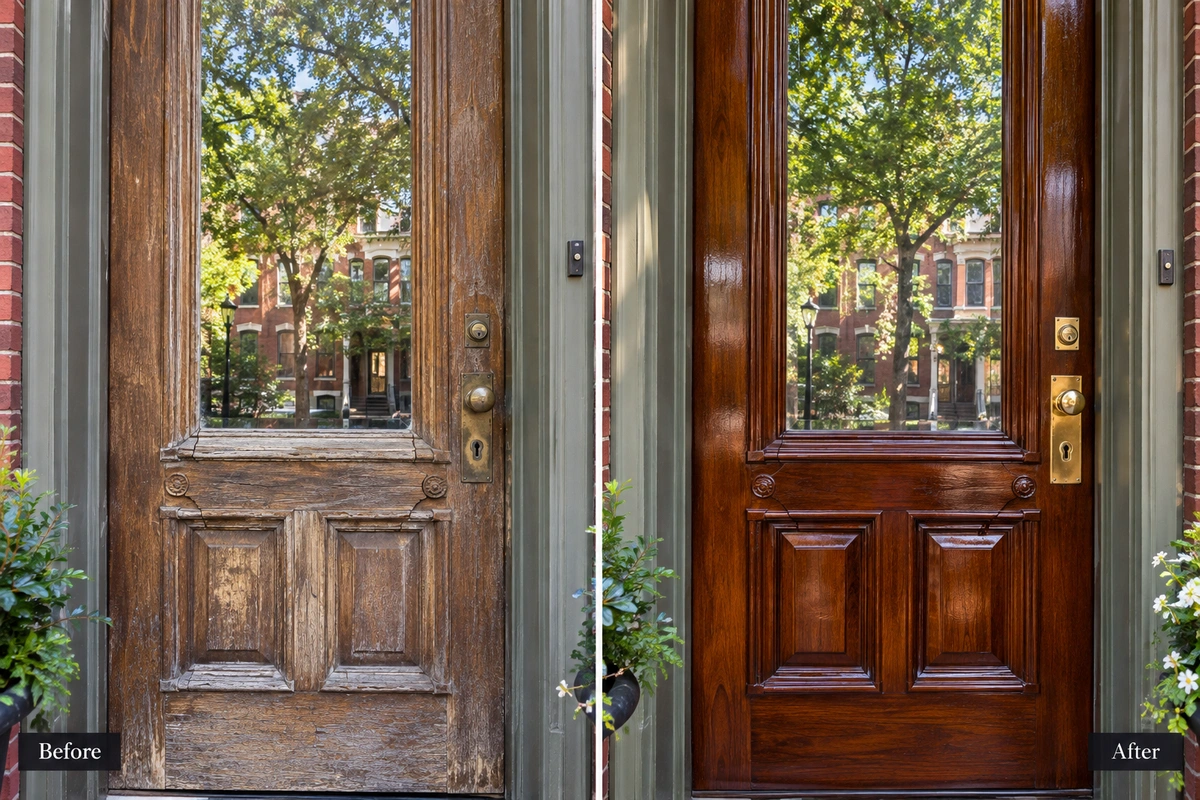
“DC Wood Door Refinishing Restoration did an awesome job refinishing our front and side doors after 12 years without any maintenance. The company was responsive and scheduled/finished the work quickly and with supreme quality. And the before and after photos really say it all!” — Jacey Spratt
We’re also active across the rest of the region — our DC, Virginia & Maryland service area covers Washington DC door refinishing, Virginia door refinishing — including Arlington door refinishing, Old Town Alexandria door refinishing, Fairfax County door refinishing, Loudoun County door refinishing, and Prince William County door refinishing — plus Maryland door refinishing, including Montgomery County door refinishing. Richmond now has access to the same on-site, five-material process. For general questions our FAQ page covers what comes up most often, and our blog goes deeper into seasonal maintenance topics. Our before-and-after portfolio shows the results across all of these markets.
Get Your Free Richmond Door Refinishing Quote
Send us photos of your door along with your contact details and we’ll follow up with next steps — no obligation, and no need to remove the door yourself first.