
Door Refinishing in Capitol Hill, DC
Expert wood door restoration and front door refinishing for DC’s largest historic district. Serving Eastern Market, Barracks Row, Lincoln Park, and Stanton Park with on-site refinishing built for century-old rowhouse doors.
Serving all of Capitol Hill Historic District. Fast, local response.
Door Refinishing Washington DC Team
Senior Door Refinishing Specialists · Capitol Hill Historic District Service Area
⏱ 11 min read · Published september 2026
Door refinishing Capitol Hill DC homeowners trust starts with a simple fact: your entry door is likely older than you are, and it was built to be restored, not replaced. Capitol Hill is home to the largest historic district in Washington, DC, and its rowhouses carry original wood doors that have survived more than a century of DC summers and winters. At Door Refinishing Washington DC, we specialize in on-site door refinishing and restoration for exactly this kind of housing stock — Federal rowhouses, Queen Anne row fronts, and the narrow brick homes that line Capitol Hill’s tree-shaded blocks from Lincoln Park to the Southeast Freeway.
Unlike a furniture restorer who removes your door and takes it to a shop, or a painter who covers the wood grain entirely, our process is built around preserving the door in place — sanding, repairing, staining, and sealing it on your stoop, without disrupting your household or altering the historic character that makes Capitol Hill what it is.
Why Capitol Hill’s Historic Rowhouse Doors Need a Specialist, Not a Handyman
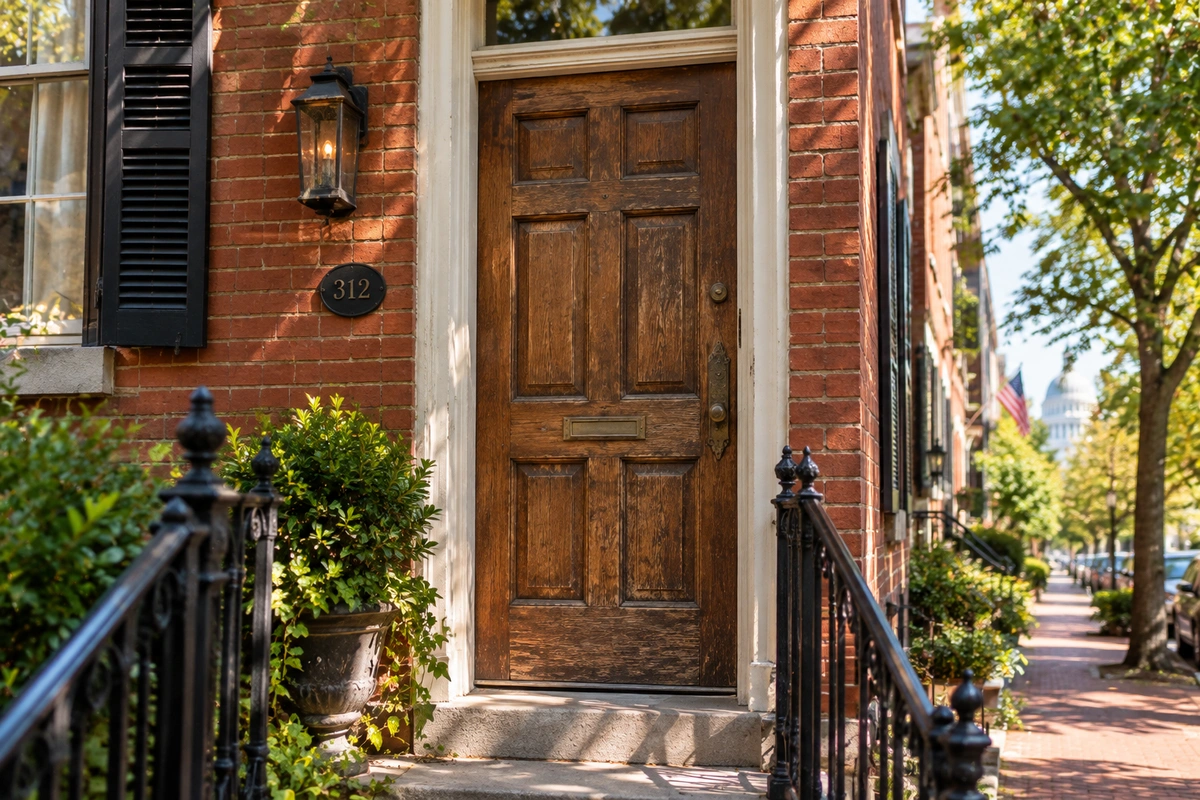
Walk any block between Eastern Market and Stanton Park and you’ll see the same story repeated on dozens of stoops: an original paneled wood door, decades of paint or failed varnish stacked on top of it, and a homeowner unsure whether the door underneath is worth saving. In almost every case, it is. Capitol Hill rowhouse doors were built from old-growth wood — denser, straighter-grained, and more durable than most lumber available today — and that quality is exactly why refinishing consistently outperforms replacement here, both aesthetically and financially.
The problem is that most of the contractors homeowners find when searching for help aren’t actually door specialists. Furniture restorers treat doors as a side offering and often require removing the door from its frame and hardware for days at a time. General painters can refresh the color but lack the sanding and wood-repair skill to address the cracking, checking, and moisture damage that a century-old door accumulates. Handymen and glass-repair companies solve adjacent problems — a broken pane, a sticking hinge — without addressing the finish itself. Door Refinishing Washington DC fills the gap those categories leave open: a dedicated door refinishing process, performed on-site, built specifically for the wood species and joinery found in DC’s oldest neighborhoods.
| Provider Type | What They Actually Do | What’s Missing |
|---|---|---|
| Furniture/antique restorers | Remove door, refinish off-site in a shop | Days without a functioning front door; higher cost from transport and shop overhead |
| General painters | Scrape, prime, paint (opaque finish) | Wood grain is hidden, not restored; no deep sanding or crack repair |
| Handymen | Hardware fixes, minor repairs | No finish-matching, no historic-wood expertise |
| Door Refinishing Washington DC | On-site sanding, repair, custom stain-matching, protective sealing | — |
Capitol Hill’s Architecture and What It Means for Your Door
Capitol Hill was designated a historic district in 1976 and remains, by a wide margin, the largest residential historic district in Washington, DC. Its housing stock spans nearly two centuries of building styles: flat-front Federal rowhouses from the early 1800s, ornate Queen Anne row fronts from the late Victorian era, Romanesque Revival blocks with round-arched openings, and Italianate rows with bracketed cornices and tall, narrow proportions. Each of these styles carries a distinct door type, and the refinishing approach that works for a plain Federal panel door is not the same one that suits an ornately carved Queen Anne entry with sidelights and a transom.
Door Styles Found on Capitol Hill Rowhouses
The earliest surviving flat-front rowhouses on Capitol Hill typically feature simple, unglazed paneled doors — modest, functional, and built for durability rather than ornament. Later Victorian-era rows introduced more elaborate detailing: raised panels, carved moldings, transom windows above the door, and sidelights flanking it. Our refinishing process is calibrated to the door in front of us, not a one-size template — a plain Federal panel door gets a different sanding depth and stain approach than an ornately molded Queen Anne door with delicate glazing details that need to be protected during the process.
HPRB Review and Why Refinishing Sidesteps It
This is the detail most homeowners on Capitol Hill don’t realize until they’ve already gotten a replacement quote: because the entire neighborhood sits inside a designated historic district, replacing a door visible from the street typically requires review by the DC Historic Preservation Review Board (HPRB) or falls under the Capitol Hill Restoration Society’s design guidelines. That review process can add weeks or months before a new door is even approved, on top of the fabrication and installation timeline. Refinishing your existing door doesn’t trigger that same review burden, because you’re not altering a character-defining feature — you’re restoring it. That single fact is often the deciding factor for Capitol Hill homeowners choosing between refinishing and replacement.
| Factor | Door Refinishing | Door Replacement |
|---|---|---|
| Historic district review | Typically not required — restoring, not altering | Often requires HPRB or CHRS design review for street-facing doors |
| Timeline | 1–3 days on-site | Weeks to months, including approval and fabrication |
| Original material | Preserved — old-growth wood retained | Removed and discarded |
| Character-defining detail | Restored in place (panels, glazing, moldings) | Must be replicated, if approved at all |
| Cost | Lower | Higher, especially for custom historic replication |
How DC’s Climate Affects Rowhouse Doors on Capitol Hill
Capitol Hill’s rowhouse doors face a slightly different exposure profile than suburban homes in the surrounding counties. Rowhouses sit flush to narrow sidewalks with little to no roof overhang or porch cover protecting the entry, which means the door takes direct sun and rain exposure that a suburban home’s covered porch would otherwise deflect. Add in DC’s humid subtropical climate — hot, muggy summers and cold, damp winters — and the result is a finish that degrades faster on a Capitol Hill stoop than it would on a set-back suburban entry.
Seasonal Threats to Watch
Summer humidity swelling and winter contraction both stress the joinery of a century-old panel door, and without a protective finish in good condition, that stress shows up as checking, cracking, and separated joints. Direct afternoon sun on south- and west-facing blocks accelerates UV fading and finish breakdown, while winter’s freeze-thaw cycles push moisture into any exposed grain.
| Climate Factor | Effect on Capitol Hill Doors | Why It’s Worse Here Than the Suburbs |
|---|---|---|
| Direct sun exposure | UV fading, finish breakdown | No porch overhang on most flat-front rowhouses |
| Summer humidity | Wood swelling, panel stress | Narrow street canyons trap heat and moisture |
| Winter freeze-thaw | Cracking, joint separation | Old-growth wood is durable but joints loosen with age |
| Street-level splash and salt | Base and threshold wear | Sidewalk-level entries take more foot and weather traffic than set-back doors |
Spring and early fall remain the ideal windows for refinishing work in this climate — balanced humidity lets stain and sealant cure evenly, while the extremes of summer heat and winter cold can compromise a fresh finish before it fully sets.
Our On-Site Door Refinishing Process for Capitol Hill Homes
Every project on Capitol Hill begins with an inspection that accounts for the door’s architectural style, its wood species, and the condition of any glazing, transoms, or sidelights attached to it. From there, we follow a controlled, multi-step process designed to protect original material while fully restoring the finish.
Step-by-Step Workflow
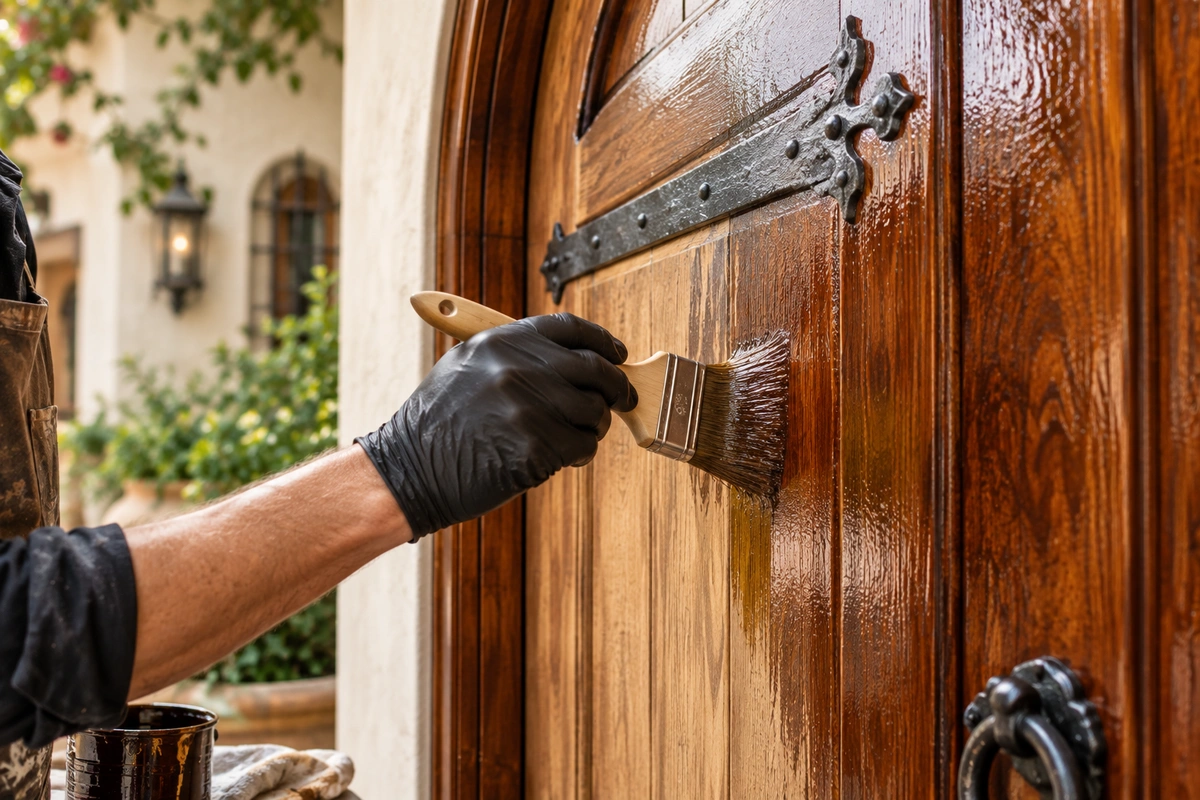
We start by protecting the surrounding stoop, trim, and any adjacent brick or ironwork before any sanding begins — Capitol Hill’s cast-iron fences and stoop rails are as much a part of the streetscape as the doors themselves, and we treat them with the same care. Old finish is removed through careful stripping or sanding calibrated to the wood’s age and density, followed by repair of any cracks, dents, or separated joints. A custom-matched stain restores the door’s original tone, and a multi-layer, weather-resistant sealant protects it against DC’s humidity and sun exposure going forward.
| Step | Action | Result |
|---|---|---|
| Inspection | Evaluate wood species, style, and glazing | Custom treatment plan for the specific door |
| Protection | Cover stoop, trim, cast iron, hardware | No damage to surrounding historic features |
| Stripping/Sanding | Remove old finish layer by layer | Clean wood surface, panel detail preserved |
| Repair | Fix cracks, joint separation, dents | Structural stability restored |
| Staining | Custom color match to original tone | Restored, authentic appearance |
| Sealing | Multi-layer UV/moisture protection | Weather resistance for DC’s climate |
| Final inspection | Quality check, hardware reassembly | Finished door ready for daily use |
Most projects are completed in one to two days without removing the door from its frame, meaning your home stays secured and accessible throughout — an important consideration on a busy Capitol Hill block where the front door often opens directly onto the sidewalk.
Materials Suited to Historic Wood
Not every stain and sealant on the market performs well on a century-old panel door, and using the wrong product can actually accelerate damage rather than prevent it. We select materials based on the wood species we find beneath the old finish — old-growth heart pine, oak, and mahogany all behave differently under a stain — and we favor breathable, moisture-managing sealants over film-forming coatings that can trap humidity inside the wood and cause the finish to bubble or peel prematurely. This is a meaningful departure from the approach a general painter typically takes, where a single opaque coating is applied regardless of what’s underneath.
Cost of Door Refinishing on Capitol Hill
Pricing depends primarily on the door’s style, the depth of damage, and whether it carries additional detail like transoms, sidelights, or Queen Anne–era carving that requires more careful handling. Because refinishing preserves the existing door rather than fabricating a new one, it remains substantially more affordable than replacement — particularly once you factor in the historic-review timeline that replacement can trigger on a street-facing Capitol Hill entry.
| Door Type | Condition | Estimated Cost Factor |
|---|---|---|
| Flat-front Federal panel door | Light wear, intact finish | Lower cost |
| Standard rowhouse door, moderate fading | Sun/moisture damage, no structural issues | Medium cost |
| Queen Anne / Italianate ornate door | Carved detail, transom, sidelights | Higher cost due to detail work |
| Multi-door rowhouse project | Front + rear/interior doors | Discounted per door |
Where We Work in Capitol Hill
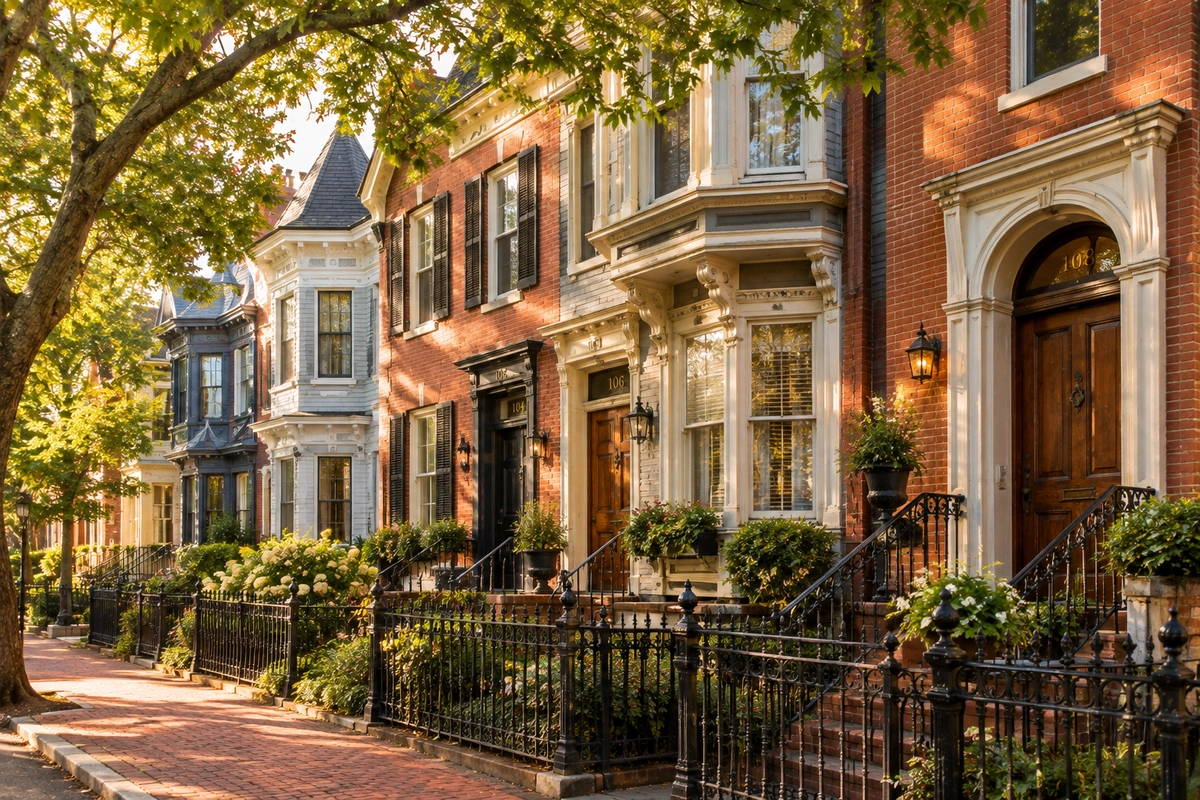
Door Refinishing Washington DC provides on-site door refinishing throughout the Capitol Hill Historic District, from the rowhouses near Eastern Market and Barracks Row to the quieter residential blocks around Lincoln Park and Stanton Park. The neighborhood’s density means our crews are frequently working block by block, which lets us schedule efficiently and offer faster turnaround windows than a contractor driving in from outside the District.
- Eastern Market
- Barracks Row (8th Street SE)
- Lincoln Park
- Stanton Park
- Pennsylvania Avenue SE
- North Carolina Avenue
- East Capitol Street
If you’re located in Washington DC but outside Capitol Hill proper, we also serve the surrounding neighborhoods and the wider DMV region.
Why Capitol Hill Homeowners Choose Door Refinishing Washington DC
Choosing the right contractor for a historic door matters more on Capitol Hill than almost anywhere else in the DMV, because a rushed or generic job doesn’t just look wrong — it can compromise a feature the historic district was designated specifically to protect. Our team approaches every Capitol Hill project with that context in mind, treating the door as both a functional entry point and an architectural artifact worth preserving.
That shows up in the details: we document each door’s style and condition before starting work, so the treatment plan matches the period the door was built in rather than applying a generic refinishing template. It shows up in our material selection, chosen for how old-growth wood actually behaves rather than for shelf convenience. And it shows up in our on-site model, which keeps your door in place and functional throughout the project instead of leaving your entry uncovered for days while it sits in a shop.
Homeowners across Capitol Hill increasingly recognize that refinishing isn’t just the more affordable path compared to replacement — for a property inside a historic district, it’s often the more practical one too, sidestepping a review process that can stall a replacement project for months. Door Refinishing Washington DC built its process around that reality, specifically for neighborhoods like this one.
Real Reviews from Door Refinishing Washington DC Customers
Hoordad Sharif — Local Guide, Washington DC ★★★★★ “I was searching for the best door refinishing in DC to save my weathered entryway, and I’m so glad I found this team. They are hands-down the experts in wood door restoration. My front door staining looks incredible, the finish is smooth, durable, and completely transformed our home’s curb appeal. If you’re looking for ‘door refinishing near me’ in Northern Virginia or Maryland, don’t hesitate.”
Brooke Piercy — Washington DC ★★★★★ “I would 100% recommend! The experience of having our doors refinished was excellent, from start to finish. The response to my initial inquiry was quick, the quoting process was clear and fair, the craftsmen arrived on time, they knew the work that was to be done, and the area was left safe and clean. Our beautiful wood doors were brought back to life.”
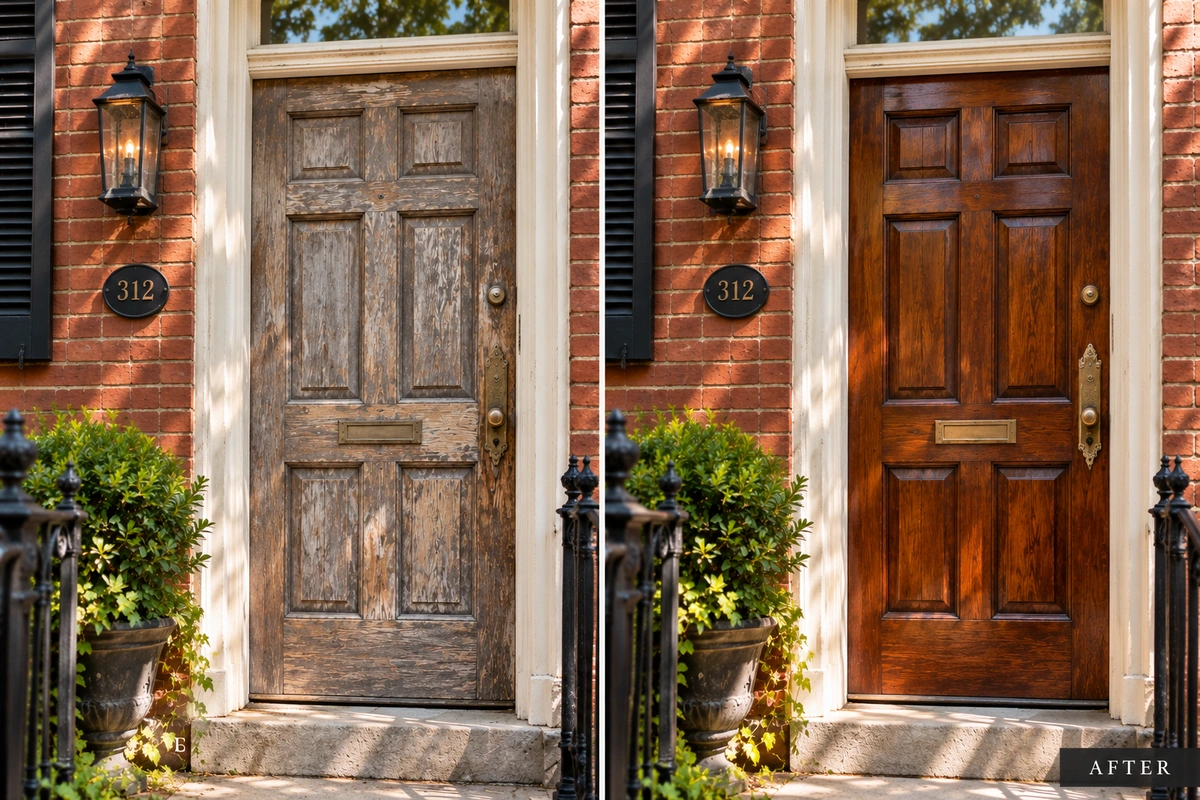
Jacey Spratt — Washington DC ★★★★★ “DC Wood Door Refinishing Restoration did an awesome job refinishing our front and side doors after 12 years without any maintenance. The company was responsive and scheduled/finished the work quickly and with supreme quality. The before and after photos really say it all.”
Free Quote — Capitol Hill Door Refinishing Estimate
Getting a quote for your Capitol Hill door starts with photos. Send us pictures of your door — including any transoms, sidelights, or carved detail — along with your address, and we’ll follow up with a clear estimate and timeline.
📍 Serving Capitol Hill, Washington DC 📞 Call: +1 (571) 500-9876 🌐 dc.doorstain.com
Frequently Asked Questions
What makes Capitol Hill door refinishing different from other DC neighborhoods?
Capitol Hill is DC’s largest historic district, and its rowhouse doors span nearly two centuries of styles — from plain Federal panel doors to ornate Queen Anne entries with transoms and sidelights. Refinishing here means matching the treatment to the specific architectural period, not applying a generic process.
Do I need historic district approval to refinish my door?
Generally no. Refinishing restores your existing door rather than altering it, which typically avoids the HPRB or Capitol Hill Restoration Society review required for a visible street-facing door replacement. Always confirm specifics with DC’s Office of Planning for your exact property, but refinishing is the lower-friction path for most homeowners.
How long does door refinishing take on a Capitol Hill rowhouse?
Most projects take one to two days, completed on-site without removing the door from its frame, so your entry stays functional and secure throughout.
Can you match the original stain color on a century-old door?
Yes. Custom stain-matching is a core part of our process, especially important on Capitol Hill where preserving the door’s original tone matters both aesthetically and for historic character.
What if my door has a transom or sidelights?
We work around glazing carefully during sanding and refinishing, treating the wood frame without disturbing original glass. Doors with this level of detail typically fall into a higher cost tier due to the additional care required.
Is refinishing cheaper than replacing a historic door?
Yes, and often by a wide margin once you account for the historic-review timeline a replacement can trigger. Refinishing preserves the original material and skips that approval process in most cases.
What types of doors do you refinish on Capitol Hill?
Flat-front Federal panel doors, Queen Anne and Italianate ornate doors, doors with transoms and sidelights, garage doors, and interior doors — wood is our focus, but we also handle fiberglass and iron doors found in some renovated properties.
How does DC’s climate affect my rowhouse door specifically?
Rowhouse doors sit flush to the sidewalk with little to no overhang, so they take more direct sun and rain exposure than a suburban entry with a covered porch. That means finishes degrade faster here, and periodic refinishing matters more.
Do you serve areas near Eastern Market and Barracks Row?
Yes. We work throughout the Capitol Hill Historic District, including Eastern Market, Barracks Row, Lincoln Park, and Stanton Park.
How do I get a quote for my Capitol Hill door?
Send photos of your door through the form above, along with your address and a note on its condition. We’ll follow up with a clear estimate and timeline — no obligation.